
Disclosure: This post contains affiliate links. If you buy through them, I may earn a commission at no extra cost to you.
Four hours. That’s about how long a closed fridge keeps food cold once the power cuts out, according to the USDA.
Now add the apartment twists: no yard, no generator, maybe stairs in the dark. Yikes!
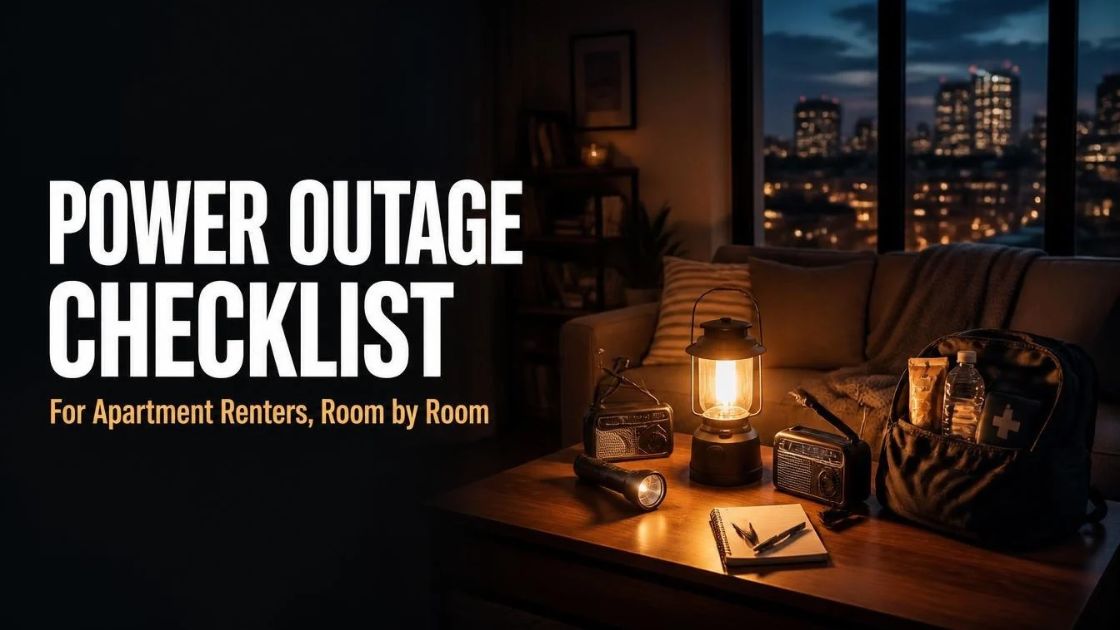
So I built this power outage checklist for apartment renters, one room at a time. You can finish most of it in a weekend, and it won’t cost a fortune.
Why Apartment Renters Need a Different Outage Plan

Renters face limits that homeowners don’t. You can’t wire in a generator or rearrange the building, and your landlord controls shared systems.
The biggest limit is safety. The CDC says carbon monoxide kills more than 500 Americans each year, and it warns against running generators or grills indoors or near doors, windows and vents.
- No gas generators: in most apartments, there’s no safe spot to run one
- No indoor grills or camp stoves: that includes closed-in balconies
- Shared building rules: check your lease before using a balcony for anything with a flame
- Battery-based solutions win: flashlights, power banks and battery radios fit small spaces
The good news? A battery-first plan takes up very little room.
Before the Lights Go Out: Building-Wide Basics

A little homework now saves a lot of stress later. Start with these building-level steps.
- Save your landlord, property manager and electric company numbers in your phone and on paper
- Find the stairwells and your nearest exit, and walk them once with a flashlight
- Ask the property manager what the building does in an outage, like emergency lighting or elevator plans
- Meet your neighbors. Check on anyone who may need help
- Use surge-protected power strips, or unplug appliances to prevent damage when power returns
Now the money question. Coverage varies a lot: Lemonade says spoiled food from an outage typically isn’t covered by standard renters policies, while Policygenius says it may be in certain cases.
So read your policy, and ask your agent. Don’t assume.
Kitchen Checklist: Keep Food Safe Without Power

The kitchen is where most apartment outages hurt your wallet. Keep the doors closed and follow the USDA’s timelines: about 4 hours for the fridge, up to 48 hours for a full freezer and about 24 for a half-full one.
- Keep thermometers in the fridge (40°F or below) and freezer (0°F or below)
- Freeze water bottles ahead of time to help keep things cold
- Keep a small cooler for fridge items you need to save
- Stock shelf-stable foods you actually like, plus a manual can opener
- When in doubt, throw it out, and never taste food to test it
- Never use a gas oven to heat your home, as the CDC warns
Want to cut food waste even more? Learning non-electric preservation methods gives you more options when the fridge goes quiet.
Living Room Checklist: Light, News and Power

This is where you’ll spend most of your time. So make it comfortable and safe.
Ready.gov advises using flashlights rather than candles, because of the fire risk. Oregon’s State Fire Marshal gave the same advice during a winter outage.
- Two flashlights or battery lanterns, plus fresh batteries
- A battery-powered or hand-crank radio, which Ready.gov includes on its kit list
- A charged power bank for your phone
- A paper list of key phone numbers
- Board games, books and a deck of cards, since boredom is real
- Unplug TVs, game systems and computers
Low phone battery is a common pain point. Turn on low-power mode and cut screen time to save charge.
Bedroom Checklist: Stay Warm, Safe and Rested

Nights feel longer in the dark. A few small items make a big difference.
- A flashlight or headlamp within arm’s reach of your bed
- Extra blankets, hats and wool socks for layers
- Spare glasses, contacts and a list of your medications
- A battery-operated carbon monoxide detector, as the CDC suggests
- Phone charger and power bank on the nightstand
If you take temperature-sensitive medicine, like insulin, talk to your doctor or pharmacist now. The FDA has emergency storage guidance, and limits vary by product.
Bathroom Checklist: Water, Hygiene and First Aid

In some buildings, water pressure can drop in an outage. So have your own supply.
Ready.gov suggests one gallon of water per person per day for at least three days. Store it in cool, dark spots like under the bed or in a closet.
- Stored drinking water (and extra for pets)
- A first aid kit and any prescription medicines
- Hand sanitizer, wet wipes and toilet paper
- Unscented household bleach for emergencies, with the CDC’s directions on hand
- Soap and a small trash bin with bags
If you must treat water, the CDC’s guide says to boil it for 1 minute (3 minutes above 6,500 feet), or disinfect with bleach as directed.
Entryway and Closet: Your Go-Bag and Documents

If the outage lasts, you may need to leave. A grab-and-go bag makes that easy.
- Copies of your ID, lease and insurance papers in a waterproof bag
- Some cash in small bills, since card readers may be down
- A change of clothes, a flashlight and a whistle
- Medications for a few days
- A backup phone charger and a paper map
- A list of friends or family who could host you
Put it by the door, and let everyone in your household know where it is.
Beyond the Checklist: Low-Tech Skills for Small Spaces

A checklist gets you ready. Skills keep you comfortable for longer.
That’s why some renters also look at a beginner survival program like BlastProof: David’s Shield. According to the sales page, it’s $67 with a 60-day money-back guarantee, and covers topics like non-electric food preservation, heat and light, and a DIY Faraday enclosure.
I haven’t read inside the guide, and some topics, like generators, won’t apply to apartments. Read my full David’s Shield review first.
One cheap idea that does fit a small space is storing a spare radio, phone and charger in a Faraday cage, such as a metal can with a tight lid. A BCIT physics demo shows metal blocks a radio signal where plastic doesn’t, but treat it as an extra layer, not a guarantee.
Frequently Asked Questions

What should renters do first when the power goes out?
Check whether it’s just your unit, then report the outage to your landlord or utility. Keep the fridge shut and use a flashlight.
How long does food last in a fridge without power?
About 4 hours if the door stays closed, according to the USDA. A full freezer holds about 48 hours.
Can I use a generator in an apartment?
Not indoors, and not near windows, doors or vents. The CDC warns about deadly carbon monoxide, so a battery power bank is the safer choice for most renters.
Is it okay to use candles?
It’s not recommended. Ready.gov advises flashlights instead because of the fire risk.
Does renters insurance cover outages?
It depends on your policy and the cause of the outage. Call your insurer and ask before you need it.
Conclusion: Small Steps, Big Peace of Mind
You don’t need a big house or a lot of cash to handle a blackout. You need a plan for each room, a few batteries and some safe habits.
Start with light, water and food. Then add the go-bag, a documents folder and your building’s contact numbers.
If you’d like to learn more low-tech skills, a guide like David’s Shield is one place to start, and the guarantee gives you time to decide.
Sources and Further Reading
- Ready.gov: Power Outages
- Ready.gov: Build a Kit
- USDA: Avoid Foodborne Illness During Temporary Power Outages
- WGBH: How to Handle a Winter Power Outage
- CDC: Avoiding Carbon Monoxide Poisoning
- CDC: Prevent Carbon Monoxide Poisoning
- CDC: Making Water Safe in an Emergency
- FDA: Information Regarding Insulin Storage and Switching Between Products in an Emergency
- Lemonade: Does Renters Insurance Cover Power Outages?
- Policygenius: Does Renters Insurance Cover Food Loss?
- Wikipedia: Faraday Cage
- BCIT Physics Commons: DEM81 Faraday Cage Demonstration
- LifeTranq: David’s Shield Review