
Disclosure: This post contains affiliate links. If you buy through them, I may earn a commission at no extra cost to you.
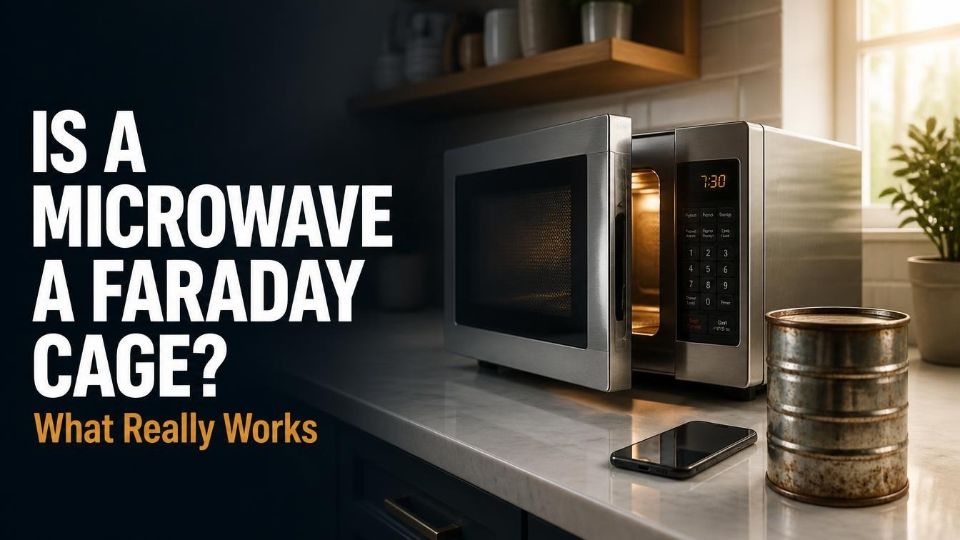
Your microwave is already a metal box built to trap energy inside. So can it also protect your phone from an EMP?
It’s one of the most popular prepper questions out there, and the answer is “sort of, but not the way you’d hope.” Let’s sort out what’s true and what’s a myth!
Below, I’ll explain how a microwave works as a Faraday cage, how to test yours with a phone, and what’s safer to use instead.
The Short Answer: Is a Microwave a Faraday Cage?

Yes, kind of. Live Science explains that a microwave oven is a form of Faraday cage because it keeps microwaves trapped inside so they heat your food.
But here’s the catch. It’s built to block one frequency from escaping, not to shield a stored phone from everything outside.
- For its own frequency: it works very well (that’s its job)
- For other signals: it may leak, depending on the model and its age
- For an EMP: it’s unproven, so don’t count on it
In other words, a microwave is a great science example. It’s just not a great storage plan.
Why a Microwave Acts Like a Faraday Cage

A Faraday cage blocks some electromagnetic fields. To work well, any holes in it must be significantly smaller than the wavelength you want to block.
That’s exactly how your microwave door is designed. The Straight Dope explains that microwaves at 2,450 MHz have a wavelength of about 12 centimeters, while the mesh holes in the door are only about 1 to 2 millimeters wide.
- Metal walls: keep energy from passing through
- Metal mesh in the door: lets you see inside without letting microwaves out
- Tight door seals: close the gaps
- Safety rules: the FDA limits leakage to 5 milliwatts per square centimeter at about 2 inches from the oven
So the “cage” part is real. But a cage designed for one frequency isn’t a one-size-fits-all shield.
The Phone Test: How to Check Your Microwave

Want to see for yourself? This is a classic classroom experiment.
A Toronto Metropolitan University lesson plan uses a phone to test whether a microwave blocks signals. If the phone rings, it means the microwave doesn’t work as a Faraday cage for that frequency.
- Step 1: Unplug the microwave first. You will not turn it on.
- Step 2: Place a charged phone inside and shut the door fully.
- Step 3: Call the phone from a second phone.
- Step 4: If it rings, the signal got through. If it doesn’t, the microwave blocked that signal.
- Step 5: Repeat with Wi-Fi turned on, if you want to check another frequency.
The lesson plan lists phone signals at about 700 MHz and Wi-Fi at about 2.4 GHz, and notes most microwaves run at 2.45 GHz. It also warns that these cages aren’t perfect and can “leak.”
Pro tip: a “no ring” result only tells you about that signal, on that day. It doesn’t prove EMP protection.
Is a Microwave a Good Faraday Cage for an EMP?

This is where I’d pump the brakes. Live Science notes that, because of how strong an EMP’s electric field is, a cage would need to be as watertight as possible, with thick conductive sides and no holes.
A microwave has a power cord, vents, a mesh window and a door seal that can wear out. That’s a lot of openings for a project that needs to be airtight.
- It’s thin metal: not designed for strong pulses
- It has vents and a window: more places for energy to get in
- It’s tied to a power cord: another possible path, even when it’s off
- Seals wear down: the FDA tells owners to contact the maker if the hinges, latches or seals are damaged
- Nobody has tested it for this: the DOE admits there are still gaps in what we know about EMP effects
My honest take? It’s fine as a free, extra layer if you already own one. But I wouldn’t make it your main plan.
Safety First: Don’t Make These Microwave Mistakes

Using an appliance in a way it wasn’t made for can go wrong fast. Keep these rules in mind.
- Never turn it on with electronics inside: it’s an easy way to ruin them
- Unplug it when storing items: so no one starts it by accident
- Don’t use a damaged microwave: a broken door or seal may leak
- Tell your family: a phone left inside by mistake can get cooked
- Don’t store food and gadgets together: keep a clear label on the door
The Oregon Health Authority also notes that microwave ovens are required to have two independent interlock systems that stop microwaves when the door opens.
Those safeguards are for cooking, not for storage. So treat any “microwave as a safe” idea with a grain of salt.
What Works Better Than a Microwave

If you want a sturdier option, a dedicated container is the way to go. A classic BCIT physics demo shows that a metal can blocks a radio signal while a plastic bucket does not.
- A metal trash can with a tight lid: roomy and cheap
- A metal ammo can: smaller, with a built-in seal
- A cardboard or foam lining: keeps devices off the metal
- Foil or conductive tape: helps seal the seams
- A radio test: check it before you trust it
Want guidance? According to the sales page, BlastProof: David’s Shield includes a DIY Faraday enclosure method made from household items, for $67 with a 60-day guarantee.
I haven’t read inside the guide, and it isn’t a guarantee of protection. Check my full David’s Shield review before you decide.
Frequently Asked Questions

Is a microwave a Faraday cage?
Yes, partly. It’s designed to keep its own microwaves inside, but it isn’t a perfect cage for every signal.
Can I put my phone in the microwave to protect it from an EMP?
It’s not recommended. The protection is unproven, and someone could turn the microwave on by accident.
Does a microwave block cell phone signals?
Often it blocks a lot of the signal, but not always. The lesson plan says if the phone rings, the microwave doesn’t block that frequency.
Is a microwave safe if it leaks?
The FDA sets strict leakage limits for new ovens. If your door, hinges or seals are damaged, stop using it and contact the manufacturer.
What is the best household Faraday cage?
A metal can with a tight lid, lined inside and tested with a radio, is a popular choice. It’s still not lab-certified, so use it as one layer of your plan.
Conclusion: A Good Science Trick, Not a Prepping Plan

So, is a microwave a Faraday cage? Partly. It blocks its own frequency well, but it can leak others and hasn’t been proven for EMP use.
Test it with the phone trick for fun, but don’t rely on it. A metal can with a tight lid is a better, safer bet, and it should be only one layer of a bigger plan.
If you’d like to learn that bigger picture, take a look at this beginner survival program and use the guarantee to decide for yourself.
Sources and Further Reading
- Wikipedia: Faraday Cage
- Live Science: What Is a Faraday Cage?
- The Straight Dope: What Keeps Microwave Radiation From Leaking Out the Oven Door?
- Toronto Metropolitan University: Is Your Microwave a Faraday Cage? (Lesson Plan)
- FDA: Microwave Oven Radiation
- Oregon Health Authority: Microwave Safety Standards
- BCIT Physics Commons: DEM81 Faraday Cage Demonstration
- DOE / OSTI: Strategies, Protections and Mitigations for Electric Grid from EMP Effects
- LifeTranq: David’s Shield Review