
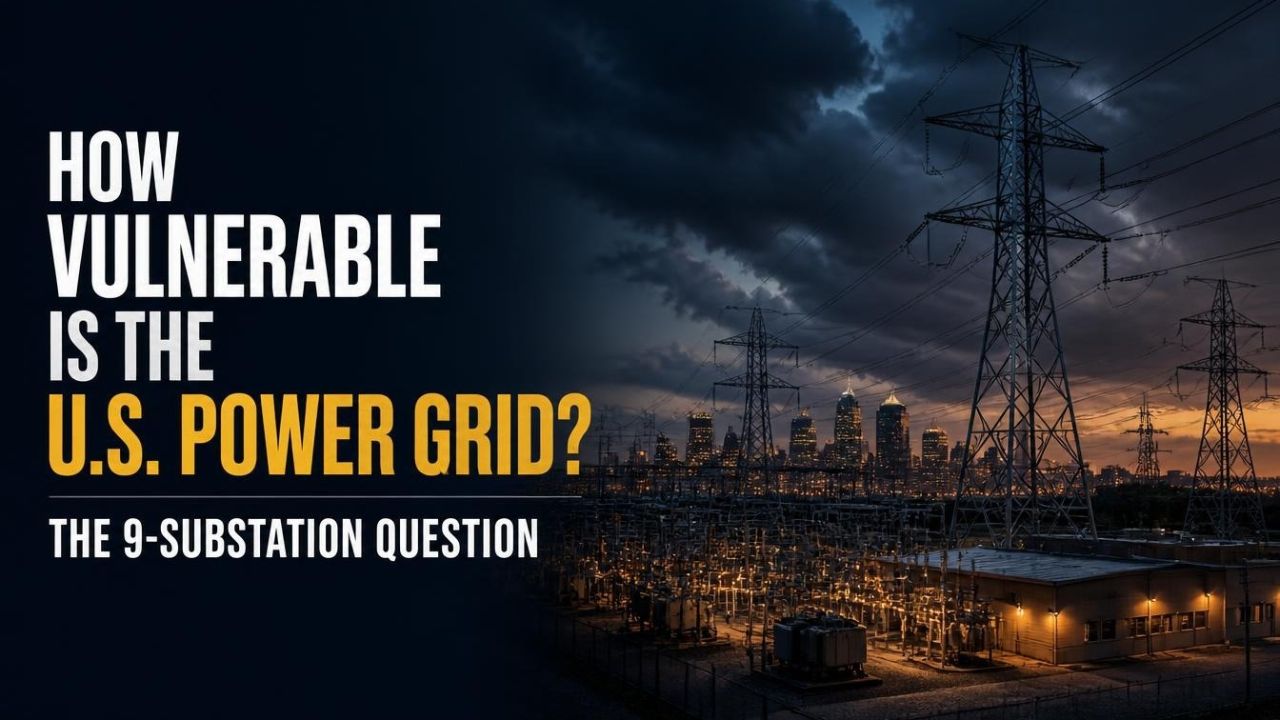
Could a small number of failures really cause a nationwide blackout? It is a question that has attracted attention for years, especially among people interested in emergency preparedness and energy security.
The so-called “9-substation question” sounds alarming. But the real story is more complicated than a simple number. To understand U.S. power grid vulnerability, we need to look at how the electrical system works, what public reports actually say, and how families can prepare for an extended outage without getting caught up in exaggerated claims.
1. How the U.S. Power Grid Actually Works
When you flip a light switch, electricity seems almost effortless. But behind that simple action is a large network of power plants, transmission lines, substations, transformers, and local distribution equipment working together.
The U.S. electrical system is often described in three broad stages: generation, transmission, and distribution. Each stage has a different job, and a problem in one area does not automatically mean the entire country loses electricity.
Generation: Where electricity begins
Power plants generate electricity using different energy sources, including natural gas, nuclear power, coal, hydropower, wind, and solar. The electricity supply must be balanced with demand because the system needs to operate within carefully managed limits.
Transmission: Moving electricity over long distances
High-voltage transmission lines carry large amounts of electricity across regions. Substations help connect different parts of the network and adjust voltage so electricity can move efficiently and eventually reach local distribution systems.

Distribution: Delivering power to homes
Local distribution networks deliver electricity from the transmission system to neighborhoods, businesses, schools, and other customers. This is the part of the system most people see through neighborhood power lines, local transformers, and utility equipment.
It is important to understand that the grid is interconnected, but it is not one simple national circuit. Different regions have different operating arrangements, and a local outage can be very different from a regional or widespread blackout.
The U.S. Department of Energy’s grid modernization information provides a useful overview of how the electricity system is evolving.
2. What Is the 9-Substation Question?
The phrase “nine substations” comes from reporting about a historical federal analysis of critical electrical infrastructure. It is often repeated online as if it proves that losing nine specific facilities would automatically shut down the entire United States.
That interpretation goes further than the public evidence supports.
A 2014 Congressional Research Service report, Physical Security of the U.S. Power Grid: High-Voltage Transformer Substations, discussed a Federal Energy Regulatory Commission (FERC) analysis of electrically significant locations. According to reporting cited in the CRS document, the analysis reportedly examined a group of critical substations and found that losing nine in certain combinations could cause a prolonged nationwide blackout in a modeled scenario.
There are several important qualifications.
- The detailed FERC analysis and its methodology were not publicly released in full.
- The reported result concerned particular modeled combinations, not any random group of nine substations.
- The CRS report also discussed questions raised about the analysis and the uncertainty surrounding the actual risk.
- A modeled scenario is not proof that a particular event will happen in the real world.
In other words, the number nine should not be treated as a magic threshold. It does not mean that nine failures always produce a nationwide blackout, or that the public knows which facilities would be involved.
Why does the story keep getting repeated?
The idea is easy to understand and remember. A complicated electrical network is reduced to one frightening number, which makes a dramatic headline.
But responsible preparedness requires more than a headline. We need to distinguish between a documented engineering concern, a theoretical model, and a verified real-world outcome.
You can read the original public discussion in the Congressional Research Service report on high-voltage transformer substations.
3. How Vulnerable Is the U.S. Power Grid Today?
The honest answer is that the U.S. power grid has real vulnerabilities, but it also has extensive reliability planning, security requirements, monitoring systems, and restoration procedures.
It would be misleading to describe the grid as either completely safe or one small incident away from total collapse.
One useful distinction is between vulnerability and probability. A system may have a component that could cause serious problems under certain conditions, but that does not tell us how likely those conditions are to occur.
Physical security risks
Electrical infrastructure includes large substations, transformers, transmission lines, and control facilities. Protecting important equipment against damage, unauthorized access, and other physical threats is an ongoing responsibility for utilities and regulators.
Cybersecurity risks
Modern electricity systems rely on digital monitoring, communications, and control technologies. Protecting those systems is important because disruptions to information and control functions can affect how utilities operate and respond to problems.
Equipment and supply-chain challenges
Large electrical transformers are specialized pieces of equipment. Replacing damaged equipment can involve manufacturing, transportation, installation, and testing, so recovery is not always as simple as swapping out a household appliance.
Extreme weather
Heat waves, winter storms, hurricanes, wildfires, and other severe weather events can affect generation, transmission, fuel supplies, and electricity demand at the same time.
NERC’s 2025 State of Reliability announcement reported that the North American bulk power system remained reliable and resilient during 2024. It also identified extreme weather as the primary cause of the most severe bulk power system outages that year.
That is a useful reminder: real grid risks are broader than the dramatic scenarios that tend to attract attention online.
See NERC’s 2025 State of Reliability announcement for its findings.
4. What Happens When a Major Substation or Transformer Fails?
Substations and transformers play important roles in moving electricity through the transmission network. A failure can create problems, but the consequences depend on the equipment involved, surrounding grid conditions, available alternatives, and the response of system operators.
There is no single outcome for every substation failure.
Possible effects of an equipment failure
- Local interruption: Customers in a limited area may lose electricity.
- Reduced transmission capacity: The system may have less ability to move electricity through a particular area.
- Rerouting and operational adjustments: Operators may use available parts of the network to maintain service.
- Wider service disruption: Under more serious conditions, problems can affect a larger region.
- Longer restoration: If specialized equipment is badly damaged, replacement and repair may take significant time.
Why transformers matter
Large power transformers are not interchangeable with small neighborhood electrical components. They are engineered for particular voltage levels and operating requirements.
The Congressional Research Service has described high-voltage transformers as critical grid components and discussed the importance of spare equipment, security planning, and recovery measures.
However, it is important not to assume that one damaged transformer—or even several equipment failures—will automatically cause a cascading nationwide blackout. Grid operators assess changing conditions and work to maintain service where possible.
For households, the practical lesson is straightforward: an outage can last longer than expected, so it makes sense to prepare for more than a brief interruption.
5. Could a Power Grid Failure Affect the Entire Country?
A widespread blackout is possible in principle, but the phrase “the entire country goes dark” can make the electrical system sound much simpler than it really is.
The U.S. power system operates through interconnected regional networks. Disturbances can spread within an interconnected system when operating conditions become unstable, but the size and duration of an outage depend on many factors.
Local, regional, and widespread outages are different
- Local outage: A neighborhood, building, or small service area loses power.
- Regional outage: A larger area experiences an interruption that may affect many communities.
- Widespread outage: Multiple areas experience major disruptions, potentially involving interconnected systems.
These events should not be treated as interchangeable. A local outage may be restored relatively quickly, while a major regional event can require more complex coordination and recovery.
Why a nationwide blackout is not a simple prediction
Grid behavior depends on electricity demand, available generation, transmission capacity, equipment condition, and operator response. A scenario that looks severe in a model does not automatically describe what would happen under different real-world conditions.
It is also worth remembering that utilities and grid operators have procedures for responding to disturbances, coordinating with neighboring systems, and restoring service.
Preparedness should account for the possibility of a long outage without assuming that the worst possible scenario is inevitable.
6. What Are the Biggest Threats to Grid Reliability?
When people discuss U.S. power grid vulnerability, physical attacks often dominate the conversation. But the reliability picture is much wider.
Several types of challenges can affect the ability of the electricity system to provide dependable service.

Extreme weather and natural disasters
Severe weather can damage infrastructure, interrupt fuel supplies, and increase electricity demand. A major heat wave, for example, can push demand higher just as equipment is operating under difficult conditions.
Winter storms can create a different set of problems, including frozen equipment, fuel supply challenges, and increased heating demand.
Growing electricity demand
Electricity use is changing as data centers, manufacturing, transportation, and other large users place new demands on the system. Generation and transmission capacity must keep pace with demand while maintaining reliability.
NERC’s long-term reliability work examines whether electricity resources and transmission plans will be sufficient to meet future needs. Its Long-Term Reliability Assessments are useful for understanding these challenges.
Cyber and physical security
Utilities must protect both physical infrastructure and the digital systems used to monitor and operate the grid. These are different security challenges, and both require ongoing attention.
Equipment replacement and recovery
Specialized equipment may require careful planning to manufacture, transport, and install. Spare equipment programs and coordination between utilities can help support recovery when serious failures occur.
Fuel and infrastructure dependencies
Electricity generation may depend on fuel supplies and other infrastructure. Disruptions in one sector can sometimes affect another, which is why reliability planning looks beyond power plants and transmission lines alone.
The Department of Energy’s work on resilient and secure energy systems describes efforts to improve threat detection, protection, response, and recovery.
7. How Can Families Prepare for a Long Power Outage?
You cannot personally repair a high-voltage transformer or control a regional electricity network. But you can make your household less dependent on immediate access to the grid.
That is where practical emergency preparedness becomes useful. Instead of trying to predict exactly what will happen, prepare for the everyday problems that a prolonged outage can create.
Build a basic household emergency supply
- Water: Store drinking water and consider how you will obtain additional safe water if the outage continues.
- Food: Keep shelf-stable meals that do not require extensive refrigeration or cooking.
- Lighting: Store flashlights, headlamps, and spare batteries.
- Communication: Keep phones, power banks, charging cables, and a battery-powered or hand-crank radio.
- Medication: Plan for prescription needs and any temperature-sensitive medicine.
- Cash: Keep some emergency cash available in case electronic payment systems are unavailable.
- Important documents: Store copies of essential information in a secure place.
Plan for phone charging
A smartphone can help you receive alerts, contact relatives, access maps, and find emergency information. But it needs power.
Consider keeping one or more charged power banks, compatible cables, and a car charger. A portable solar panel or power station may be useful for households preparing for longer disruptions, provided the equipment is suitable for the devices you intend to charge.
Think about safe backup electricity
Some households use generators or battery power stations. Follow the manufacturer’s instructions and local safety guidance.
Never operate a fuel-powered generator indoors, in a garage, or near windows and doors. Generators produce carbon monoxide, which can be deadly. Use them outdoors and at a safe distance from buildings as directed by official safety guidance.
Make a family communication plan
Write down important phone numbers instead of relying only on your phone’s contact list. Agree on a meeting place and an out-of-area contact who can help family members share updates.
For additional guidance, visit Ready.gov’s power outage preparedness page.
8. What Can David’s Shield Add to Your Preparedness Research?
Some readers want to go beyond a basic emergency checklist. They are interested in learning about household self-reliance, extended power disruptions, EMP-related concerns, and ways to organize their emergency planning.
David’s Shield is advertised as a preparedness education resource for people interested in these subjects. Its promotional material may appeal to beginners who want an organized learning resource rather than piecing together information from many different sources.
It is important to understand what the product is—and what it is not.
- It is an educational resource, not a utility service.
- It does not repair or protect the public power grid.
- It should not be treated as emergency equipment or a guaranteed protection system.
- Any recommended equipment or household changes may involve additional costs.
- Technical claims should be compared with credible evidence and independent sources.
Questions to ask before buying
Before purchasing any preparedness program, I would consider a few practical questions:
- Does the material explain its recommendations clearly?
- Are important technical claims supported by credible evidence?
- Can a beginner understand and apply the information?
- What additional equipment or expenses might be involved?
- Does the program fit your household’s actual preparedness needs?
If you want to evaluate the program in more detail, read the David’s Shield review on Lifetranq before making a decision.
Conclusion: Understand the Risk, Then Prepare Wisely
The U.S. power grid is a complex system with real reliability and security challenges. The “9-substation question” comes from historical reporting about a sensitive analysis, but it should not be treated as a proven formula for causing a nationwide blackout.
Extreme weather, equipment problems, growing demand, and security concerns all deserve attention. At the household level, the most useful response is practical preparation: water, food, lighting, backup charging, communication plans, and safe backup power.
You do not need to predict the next major outage to become better prepared. Start with the essentials, learn from credible sources, and build a plan your family can actually use.
Sources and Further Reading
- Congressional Research Service – Physical Security of the U.S. Power Grid: High-Voltage Transformer Substations
- Congressional Research Service – NERC Standards for Bulk Power Physical Security: Is the Grid More Secure?
- North American Electric Reliability Corporation – 2025 State of Reliability
- NERC – Long-Term Reliability Assessments
- U.S. Department of Energy – Resilient and Secure Systems
- Ready.gov – Power Outages