
Disclosure: This post contains affiliate links. If you buy through them, I may earn a commission at no extra cost to you.
One test. About 250 miles up. In 1962, the U.S. set off a nuclear device that high above the Pacific, and it disrupted electrical equipment in Hawaii roughly 800 miles away, according to a Los Alamos scientist’s testimony to Congress.
That’s the story behind a term you’ve probably heard: high-altitude EMP, or HEMP. But what is it, really?
Let’s skip the hype and the jargon. Here’s a plain-English explainer, plus a few calm steps you can take.
What Is a High-Altitude EMP (HEMP)? The Plain-English Definition

A nuclear electromagnetic pulse is a burst of electromagnetic energy created by a nuclear explosion. When the blast happens high above the Earth, tens to hundreds of miles up, it’s called a high-altitude EMP, or HEMP.
The Congressional Research Service says a HEMP can create a series of pulses that damage critical infrastructure on the ground. The word “damage” is important, because the effects depend on many factors.
- HEMP: a nuclear blast high in the atmosphere that creates an electromagnetic pulse over a wide area
- Not a blast wave: the pulse isn’t what destroys buildings. It affects electrical systems
- It depends: Wikipedia notes effects vary with the altitude, yield and shielding of targets
So think of it as an electrical event, not a physical explosion at ground level. That’s why scientists study it as a risk to the power grid and electronics.
How a HEMP Works: E1, E2 and E3 Explained
A HEMP isn’t just one pulse. It has three parts, called E1, E2 and E3, which happen in quick order.
The Congressional Research Service describes them in simple terms. Here’s a quick breakdown.
- E1, the fast one: it can directly affect sensitive electronics or couple into equipment through control cables and other conductors
- E2, the middle one: its effects are similar to lightning
- E3, the slow one: it can induce currents in long-distance transmission lines, which may damage large power transformers
Why does that matter? Different parts hit different things. E1 is about small electronics, and E3 is about the big power grid.
Wikipedia adds that E1 changes too quickly for ordinary surge protectors to stop it, though special fast-acting protectors can help. An E3 pulse is thought to couple well with very long lines, about 100 km or longer.
A Real Example: Starfish Prime and the 1962 Tests
The best-known example is Starfish Prime. On July 9, 1962, the U.S. detonated a 1.4 megaton device about 400 km (250 miles) above the Pacific Ocean, as Wikipedia notes.
The Los Alamos testimony says the Hawaiian island of Oahu, about 1,300 km away, was within line of sight of the detonation. Damage or upsets to electronics were noted on a number of systems in the 1958 and 1962 tests.
- The result in Hawaii: damage was reported but repaired quickly, in part because the pulse there was relatively weak and equipment of that era was rugged
- Soviet tests later in 1962: an E3-type pulse induced a current surge in a long underground power line and caused a fire at a power plant in Karaganda
- The lesson: long conductors, like power and phone lines, can act like antennas
Keep one big caution in mind. Electronics in 1962 were very different from today’s, so those results don’t map neatly onto modern devices.
How Far Could a HEMP Reach?

This is where HEMP is different from other threats. The higher the burst, the bigger the area under it.
According to the Los Alamos testimony, a high-altitude detonation could produce an EMP covering one to several million square kilometers, depending on the height of the burst.
- Wide footprint: a single burst could cover a large part of a country
- Line of sight: the pulse reaches areas that can “see” the detonation point
- Varying strength: the field is not equally strong everywhere
- Main concern: the electric grid, communications and other infrastructure
The Department of Energy has told Congress that HEMP attacks could damage power equipment and affect grid reliability. That’s why the grid is the focus.
HEMP vs. Solar Storms and Other EMPs
Not every EMP comes from a bomb. The DOE says EMPs can result from solar-caused effects or man-made devices.
A big solar storm is a natural cousin. Its effects are similar in some ways to E3, because both can push slow, strong currents into long power lines, as Wikipedia notes in its E3 description.
- HEMP: man-made, nuclear, with all three parts (E1, E2, E3)
- Solar storm: natural, slow and mostly a threat to long power lines
- Other EMP devices: smaller, with a local reach
Why care about the difference? Because your best prep for all of them looks similar: be ready for a long power outage.
What Experts Know (and Don’t) and How to Prepare Calmly

Here’s the honest part. Experts still don’t agree on exactly how bad a HEMP would be. A DOE report points out gaps in our knowledge, and the CRS says research into how newer technologies hold up is still in its early stages.
So skip the doom. Focus on simple steps that help in any long outage.
- Build a 72-hour kit: Ready.gov’s list includes water, food, a flashlight, a radio and first aid
- Store water: one gallon per person per day, for at least three days
- Keep a battery or hand-crank radio: it’s your link to news
- Back up key documents: store paper and digital copies
- Consider a Faraday container for a few backups: see how a Faraday cage works, but remember it isn’t a guarantee
If you want to go deeper on the skills side, there are beginner programs for that.
Beyond the Explainer: Why Skills Matter
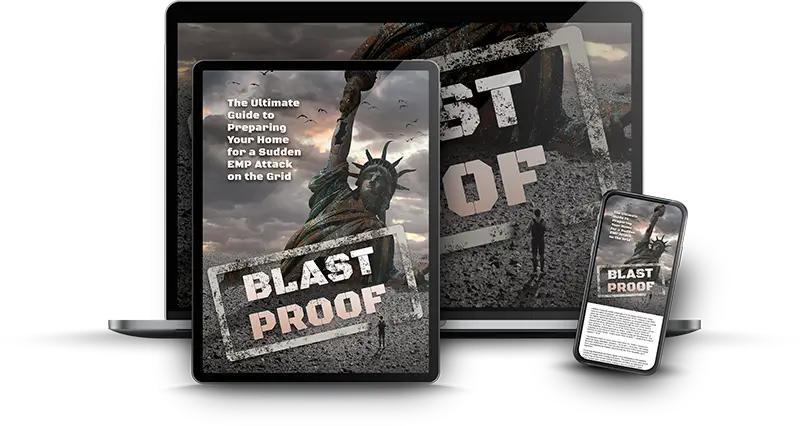
Knowing what a HEMP is helps. Knowing what to do when the power is out helps even more. That’s why some beginners look at a low-tech skills program like BlastProof: David’s Shield.
According to the sales page, it’s $67 with a 60-day money-back guarantee. It covers topics like food preservation, water, heat and light, and a DIY Faraday enclosure.
I haven’t read inside the guide, and it can’t promise protection from a HEMP. Read my full David’s Shield review before you decide.
Frequently Asked Questions
What is a high-altitude EMP?
It’s an electromagnetic pulse created by a nuclear detonation high above the Earth. It can affect electrical systems over a very wide area.
What do E1, E2 and E3 mean?
They’re the three parts of a HEMP. E1 is the fast pulse, E2 is similar to lightning, and E3 is a slow pulse that can affect long power lines, according to the CRS.
Has a HEMP ever happened?
Yes, in nuclear tests. The U.S. conducted several in 1958 and 1962, and the Soviet Union held tests in 1962 as well.
Is a HEMP the same as a solar storm?
No. A solar storm is natural and mostly affects long power lines, while a HEMP is man-made and has three pulse types.
How can I prepare for a HEMP?
Prepare for a long power outage: store water and food, keep a radio and flashlight, and learn a few low-tech skills.
Conclusion: Understand It, Then Prepare Calmly
So, what is a high altitude EMP? It’s a pulse of electromagnetic energy from a high-altitude nuclear burst, with three parts and a very wide reach.
The science is real, but the exact effects on today’s technology are uncertain. That’s a good reason to focus on simple steps: water, food, light, a radio and a few low-tech skills.
If you’d like a place to start, take a look at David’s Shield and use the guarantee to decide for yourself.
Sources and Further Reading
- Congressional Research Service: Ensuring Electricity Infrastructure Resilience (R47339)
- Los Alamos National Laboratory: Congressional Testimony on High-Altitude EMP (1999)
- Wikipedia: Nuclear Electromagnetic Pulse
- U.S. Department of Energy: Testimony Before the Senate Homeland Security Committee (2019)
- U.S. Department of Energy: EMP Resilience Action Plan (2017)
- DOE / OSTI: Strategies, Protections and Mitigations for Electric Grid from EMP Effects
- Ready.gov: Build a Kit
- Wikipedia: Faraday Cage
- LifeTranq: David’s Shield Review