
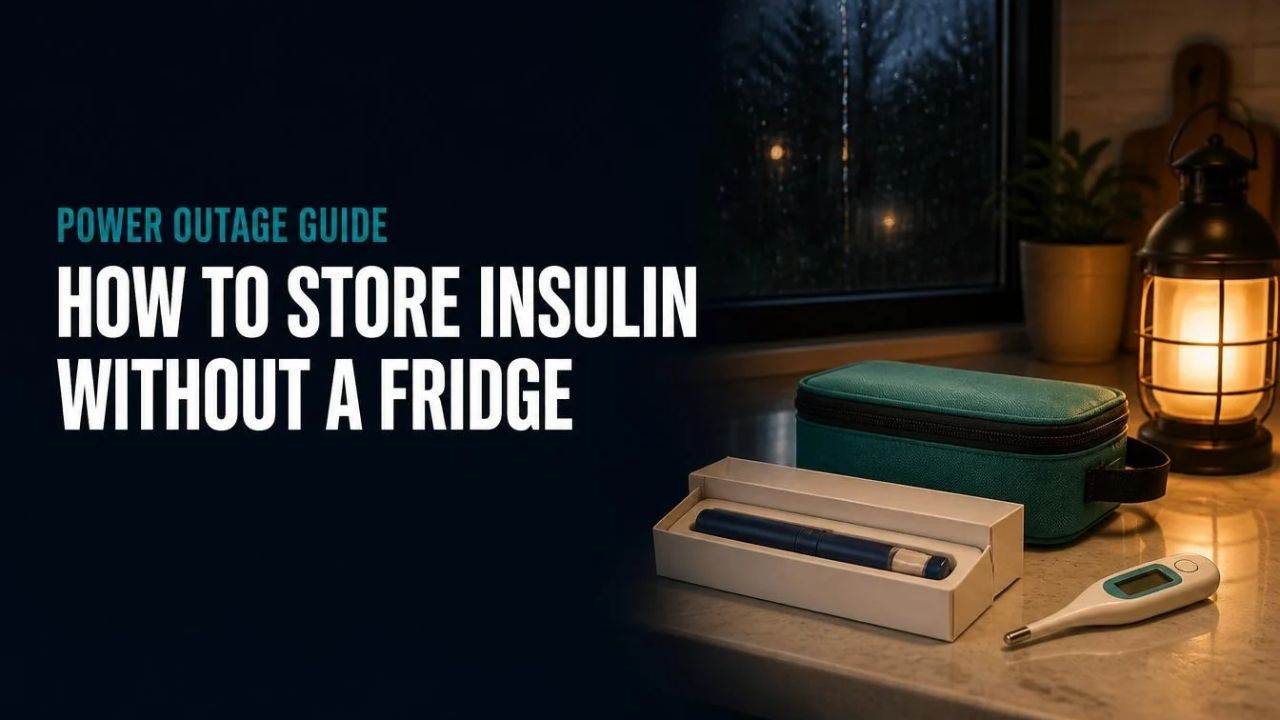
If you need to store insulin without refrigeration, check the instructions for your exact product. Some insulin can stay at room temperature for a limited time, but the limit depends on the product and how it’s packaged. Keep it away from direct heat and sunlight, and never use insulin that has frozen, according to the FDA’s emergency insulin guidance.
I’d start with the carton, not the ice. Here’s what to check first, how to use a cooler without freezing your supply, and when to stop guessing and call for help.
What to Do With Insulin When the Power Goes Out

Start with a question that’s easy to miss: Which insulin is in the fridge, and which are you already using? An unopened supply and an in-use pen can have different instructions. For example, unopened Lantus SoloStar pens can be refrigerated, but an in-use pen should be kept at room temperature below 86°F (30°C), according to the Lantus prescribing information.
If your unopened supply belongs in the fridge and a thermometer shows it’s still in the required range, there’s no need to rush it into a cooler. Keep the fridge door closed as much as possible, and let the temperature and the medication label guide your next move. The FDA gives 36°F to 46°F (2°C to 8°C) as the usual refrigerated range for unopened injectable insulin in its emergency storage guidance.
- Read the carton: Record the brand, strength, and whether you have a vial, cartridge, or pen.
- Note the time: Write down when the outage started, when you opened or moved the insulin, and any temperatures you actually measured.
- Keep the packaging: Leave the label with the insulin so you don’t have to identify a pen by its color in the dark.
- Call if you’re unsure: Ask a pharmacist or the manufacturer what to do if you don’t know how warm or cold the insulin got. The FDA lists contacts in its emergency insulin guide.
Here’s how I’d handle an overnight outage: If I woke up at 6 a.m. and the clocks were blank, I’d write “outage start unknown,” not “6 a.m.” I’d note the temperature I could measure now and tell the pharmacist what I couldn’t verify.
I’d also put the pharmacy number somewhere I could find it without Wi-Fi. If the house was warming fast or I had to evacuate, I’d get the medication, its carton, and the written notes together before sorting out anything else. The goal isn’t to reconstruct every minute of the blackout; it’s to give the person helping you enough information to make a useful call.
How Long Can Insulin Stay at Room Temperature?

There’s no single room-temperature limit for every insulin. The FDA’s emergency guidance says insulin in original manufacturer-supplied vials or cartridges, opened or unopened, can generally be kept at 59°F to 86°F (15°C to 30°C) for up to 28 days. That’s a general emergency reference, not a substitute for the instructions on your exact product or for insulin already in a pump reservoir. See the FDA’s storage and pump guidance.
Here’s why I’d check the label even if I remembered the 28-day number. Two pens can look like they belong in the same storage setup, yet have different rules:
- Lantus SoloStar: An in-use pen is kept at room temperature below 86°F (30°C), not refrigerated, and discarded after 28 days. See the Lantus SoloStar label.
- Tresiba FlexTouch: An in-use pen can be stored refrigerated or at room temperature up to 86°F (30°C) for up to 56 days. See the Tresiba FlexTouch label.
Those are storage examples, not reasons to switch products. If you take more than one insulin, give each its own line on your storage card: brand and strength, pen or vial, opened or removed from the fridge on, temperature limit, discard date. Ask your pharmacist which event starts the countdown for each product and how to handle time spent out of the fridge. Don’t assume that putting insulin back in the fridge resets anything.
Using an insulin pump? Check both the insulin label and the pump manual for the reservoir and infusion-set rules. The FDA says to discard pump insulin exposed to temperatures above 98.6°F (37°C), and notes that replacement intervals can differ by insulin and device. Ask your diabetes team for a written backup plan before you need one, rather than trying to work out injection doses during a pump failure. See the FDA’s emergency guidance for pump users.
How to Keep Insulin Cool Without Freezing It
My first instinct in a summer outage would be to reach for a frozen gel pack. The important part is what happens next: Don’t lay the insulin directly on the pack or bury it in ice. If you need an insulated cooler because the room is getting too warm or you have to leave, keep the medication physically separated from the cold source, as advised in the CDC’s diabetes and heat guidance.
I’d put a thermometer near the medication, not against the ice pack. Then I’d check the reading against the product label and write it down. An insulated bag can help protect insulin in transit, but “the bag feels cold” doesn’t tell you whether the medication stayed in the right range.
- At home: Pick a spot away from sunny windows, heaters, and other sources of direct heat.
- In a cooler: Keep the carton separated from ice or frozen gel packs and check the temperature near the medication.
- On the road: Keep insulin with you rather than leaving it in a parked car. The CDC’s diabetes travel guidance warns against hot cars, direct sunlight, and direct contact with ice.
- In winter: Don’t use a snowy porch or an unheated car as a substitute fridge. The FDA says not to use insulin that has frozen.
If you’re shopping for a no-power medication cooler, ask what temperature range it’s designed to maintain. Is it meant to keep an in-use pen within its room-temperature limit, or to keep an unopened supply within its refrigerated range? Those are different jobs, and I wouldn’t buy a case until I knew which job I needed it to do.
What about a clay pot or another DIY evaporative cooler? A Cochrane review of human insulin storage found that simple cooling devices can lower the surrounding temperature, but it also called for more clinical studies. That isn’t proof that a homemade setup will keep your particular insulin within its labeled limits. I’d plan around a measured temperature and a replacement option, not a promise from a gadget or a guide.
What to Do if Insulin Got Too Hot or Froze

If you know the insulin froze, don’t use it, even after it thaws. Arrange a replacement right away. If it got too hot, write down the highest temperature you know and how long it might have been exposed, then call a pharmacist or the manufacturer. Heat can make insulin less effective, and the FDA advises replacing insulin exposed to extreme temperatures as soon as properly stored insulin is available. See the FDA’s guidance on extreme temperatures.
Here’s the hard case: What if the only insulin you have got too warm? The CDC recognizes that you may have to use heat-exposed insulin in an emergency and advises regular blood glucose checks if you do. Seek medical guidance and a proper replacement urgently rather than skipping doses, changing your dose on your own, or assuming everything is fine because the liquid looks normal. See the CDC’s advice on using insulin in an emergency.
I’d make the first call before the last usable dose, not after it. A simple script is enough: “I use this brand and strength, I have this much left, and I don’t know how warm it got. Where can I get a properly stored replacement today?” If you’re in an emergency shelter, tell staff you rely on insulin and need help getting supplies or medical care. The CDC’s emergency assistance page also lists a U.S. support line for people affected by storms.
- If you’re sick or your blood sugar is 250 mg/dL or higher: The CDC advises checking blood sugar every 4 to 6 hours and checking for ketones. Also check for ketones if you have symptoms of diabetic ketoacidosis (DKA).
- Go to the emergency department or call 911 in the U.S. if ketones are high, blood sugar stays at 300 mg/dL or higher, your breath smells fruity, you can’t keep food or fluids down, or you have trouble breathing. Don’t wait for the power to come back. See the CDC’s DKA testing and emergency guidance.
Build a Diabetes Emergency Kit and a Blackout Plan

I’d do a five-minute practice run in daylight: Find the kit, read the insulin label, and locate the after-hours pharmacy number without using your phone. If someone else in the household can do those three things without asking you where to look, the plan is in decent shape. If not, that’s a useful thing to find out on a Tuesday afternoon instead of in the middle of a storm.
The CDC recommends packing enough diabetes supplies for at least one to two weeks. Ask your pharmacist what you can keep in reserve, how to rotate it, and what to do if you need an emergency refill. Use the CDC’s diabetes emergency kit checklist as a starting point.
- Medication and delivery supplies: Insulin stored as directed, plus pen needles, syringes, or pump supplies as appropriate.
- Monitoring and low-blood-sugar supplies: A glucose meter, test strips, lancets, spare batteries, ketone tests, fast-acting glucose, and glucagon if prescribed.
- Cooling and records: An insulated medication case, a thermometer, printed prescriptions, and a waterproof copy of your medication list.
- People and places: Your diabetes team’s number, an alternate pharmacy, and a place you could go if your home gets too hot or cold.
Where David’s Shield fits in a household preparedness plan
Affiliate disclosure: If you buy through the David’s Shield links or buttons below, we may earn a commission.
Once the diabetes plan is set, the David’s Shield preparedness guide may be worth browsing if you’d like a Christian-oriented introduction to household blackout planning and low-tech skills. It’s educational material, not emergency equipment, a guarantee of protection, or a substitute for professional advice. That distinction is also made in the seller’s presentation.
Before spending money, read the LifeTranq review of David’s Shield. It’s based on the sales presentation and product details, not a read-through or a test of the guide, so use it to decide what questions to ask rather than as proof that any method works.
If you’re comparing resources, check the current offer, what’s included, and what supplies any projects would cost. I’d put the medication kit and a reliable replacement plan ahead of optional off-grid preparedness reading. You don’t need to buy anything from the guide to use the insulin plan on this page.
Write Down Your Insulin Plan Before the Next Outage
To store insulin without refrigeration, start with the exact product label. Keep it away from direct heat and sunlight, don’t let it freeze, and call for advice if you can’t verify how it was stored. If you need replacement insulin, start arranging it before you run out. Keep the FDA’s emergency storage guidance with your plan.
My pick for the most useful thing you can do today? Write your insulin name, storage limits, and pharmacy number on one card. Ask your pharmacist to check it, then put it where someone else can find it in the dark. That’s one less decision to make when the fridge goes quiet.