
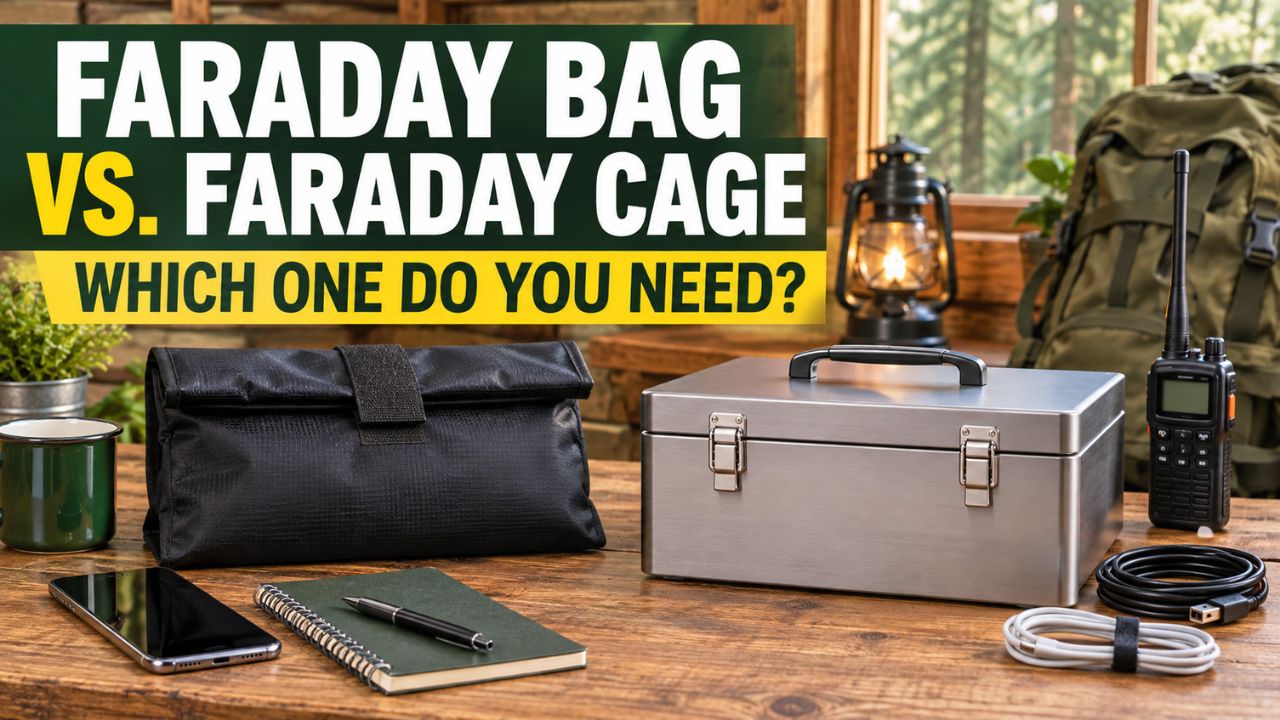
Faraday Bag vs Faraday Cage: Understand the Difference

A Faraday enclosure uses conductive material to reduce electromagnetic coupling between its interior and exterior. In everyday shopping language, “Faraday bag” usually means a flexible pouch, while “Faraday cage” often means a rigid enclosure.
That distinction describes construction, not a guaranteed protection level. A well-designed bag may outperform a poorly sealed metal box.
The CISA EMP Protection and Resilience Guidelines discuss both bags and rigid enclosures. They emphasize that frequency coverage varies and that a bag’s closure can be its main leakage point.
That is the first useful lesson: the entire enclosure matters. Conductive fabric or metal is only one part of the finished product.
| Question | Faraday Bag | Rigid Faraday Enclosure |
|---|---|---|
| What is the typical format? | Flexible pouch, sleeve, or bag | Box, case, cabinet, or shielded room |
| What practical advantage stands out? | Convenient portability | Structured, stationary organization |
| What needs close inspection? | Closure, seams, folds, and fabric condition | Lid, joints, gaskets, openings, and penetrations |
| Does the format prove EMP protection? | No; examine relevant test evidence | No; examine relevant test evidence |
I would also separate ordinary radio-frequency signal blocking from broader EMP-resilience claims. A product description that mentions phones or key fobs does not, by itself, establish performance against a specified electromagnetic pulse.
CISA’s guidance distinguishes protection levels and increasingly demanding installation requirements. A household purchase should not borrow the credibility of those guidelines without showing how the actual product was evaluated.
- Choose a format for your use case.
- Evaluate shielding claims separately from convenience claims.
- Ask about the complete enclosure, not just its material.
- Do not assume that “metal” means “tested protection.”
When a Faraday Bag Makes More Sense
I would put a bag on the shortlist when portability is the main requirement. A flexible pouch can fit into a travel organizer or emergency kit more conveniently than a bulky stationary enclosure.
CISA describes Faraday bags as a basic shielding option used for small electronics, including phones, key fobs, tablets, laptops, and handheld radios. But the guidance also warns that frequency coverage differs between products.
So, “fits my phone” and “meets my shielding requirement” are separate checks. Get both answers before buying.
Imagine a traveler who wants a pouch for a spare device. The sensible checklist includes the device’s dimensions, the closure instructions, the relevant test report, and how the pouch will be packed.
There is also an access tradeoff. If the bag successfully blocks the relevant signals, a device inside may not receive the wireless communications you expect.
I would not casually shield the only phone needed for immediate contact. Decide in advance which devices must stay accessible and which are being stored.
- Check internal dimensions with room to close the pouch correctly.
- Follow the exact fold, roll, or fastening instructions.
- Inspect seams, closure surfaces, and fabric for damage.
- Keep the manufacturer’s care instructions with your equipment records.
- Reassess the product if its condition changes.
The closure deserves special attention because CISA identifies it as a common weak point. A pouch should not be considered sealed merely because it looks shut.
For a travel checklist, I would add one final question: can every intended user close it properly without guessing? Practical usability belongs beside the technical specifications.
When a Rigid Faraday Enclosure Makes More Sense

A rigid enclosure belongs on the shortlist when you want a dedicated storage location for several spare items. A fixed case or cabinet can be easier to organize than a collection of individual pouches.
However, its physical structure and its electromagnetic performance are different characteristics. A sturdy box can protect against bumps without providing the shielding performance you need.
CISA’s guidance discusses protective metal barriers, shielded cases, cabinets, and larger facilities. It also warns that ordinary metal trash cans do not usually provide reliable EMP protection unless appropriately modified.
That warning is useful. It stops the common leap from “the container is metal” to “the equipment inside is protected.”
Doors, lids, joints, and openings all need scrutiny. The same applies to any cable that passes from the outside into the protected space.
CISA’s resilient-power guidance treats shielding, bonding, grounding, and protection of incoming lines as related engineering issues. A cable crossing the boundary is not a detail to improvise.
- Measure the equipment and accessories you intend to store.
- Inspect the enclosure’s lid, joints, and closure system.
- Ask whether testing covered the assembled case.
- Check how any required cable entry is handled.
- Keep the enclosure’s physical-protection claims separate from shielding claims.
For a hypothetical cabin setup, a rigid case might hold spare communications equipment in one labeled location. That organization can be useful even before shielding performance is considered.
But I would still require evidence for the protection claim. An orderly shelf is a planning improvement, not a laboratory test.
How to Evaluate Shielding Claims Before Buying
This is where I would spend the most research time. Product names such as “military grade,” “EMP ready,” or “signal proof” do not answer the technical questions on their own.
Ask for shielding-effectiveness information across the frequencies relevant to your use. A single impressive number without test conditions leaves too much unexplained.
CISA specifically advises looking for evidence that the entire bag has been tested. A material sample can perform well while a finished product leaks at its closure.
When reviewing documentation, I would look for the tested model, test method, frequency range, attenuation results, and closure configuration. If the report describes a different product, ask how it supports the item you are buying.
- Was the complete product tested, including its closure?
- Which frequencies were evaluated?
- What shielding effectiveness was measured across that range?
- Who performed the testing, and is the report available?
- Does the report identify the current model and configuration?
- Are claimed standards supported by actual documentation?
What about placing a phone inside and calling it? That can be a limited practical check, but it cannot establish performance across every relevant frequency or exposure condition.
A missed call tells you less than many demonstrations imply. It is not equivalent to the complete-enclosure testing and defined performance requirements discussed in CISA’s guidelines.
Likewise, a successful call is a reason to investigate the setup, closure, and product claim—not a reason to invent a protection rating.
Keep the limitations written beside your test notes. I would rather have an honest “not verified” entry than a confident label based on a five-minute experiment.
For connected equipment or a permanent installation, seek qualified technical advice. Grounding and incoming power or data lines involve more than deciding whether to attach a wire to a box.
Build a Practical Plan—and Evaluate David’s Shield Separately
My decision rule is straightforward: shortlist a bag for portable storage, a rigid enclosure for an organized fixed location, and neither until you understand the intended protection requirement.
Then compare evidence and implementation costs. Spending more on a larger enclosure does not remove the need to examine its test report.
For preparedness-minded families, I would also keep the goal realistic. Protecting a spare device does not guarantee functioning networks, available electricity, or a complete household emergency plan.
Faith can motivate stewardship and preparation without replacing technical evidence. Those two parts of planning do not need to compete.
- List what you want to store and why.
- Decide whether portability or stationary organization matters more.
- Request performance documentation for the shortlisted products.
- Budget for the actual hardware and any required professional help.
- Write an access, inspection, and maintenance routine.
David’s Shield’s vendor page describes its offer as educational information and DIY plans. That makes it a separate purchase from a tested shielding pouch, case, or installed enclosure.
The accessible sales-page text does not establish a verified Faraday-system bill of materials, shielding test result, or complete implementation cost. Do not assume those details merely because the page discusses blackouts or EMPs.
You can visit the David’s Shield review as an additional research step. Compare its statements with the current vendor information rather than treating either page as independent performance certification.
Before purchasing, ask what is included, which instructions address your goal, what materials cost extra, and what evidence supports any protection claim. Check current support and refund terms too.
If an organized learning resource fits your needs, review the current David’s Shield details. Treat the guide as something to evaluate, not protection you have already achieved.
Conclusion: Choose the Use Case First, Then Check the Evidence
The Faraday bag vs Faraday cage decision is not about finding one universal winner. A bag offers a portable format, while a rigid enclosure can suit a fixed, organized storage plan.
For either option, the complete product, closure, frequency coverage, and relevant testing matter more than the label. A phone-call demonstration does not establish comprehensive EMP protection.
Start with your equipment list and intended use, then compare documented performance and total costs. If David’s Shield interests you, evaluate it separately as an educational resource—not as shielding hardware or a guaranteed outcome.