
An honest, research-backed look at the faith-based off-grid water program taking the prepper community by storm — and whether it actually delivers.
What Is Joseph’s Well?
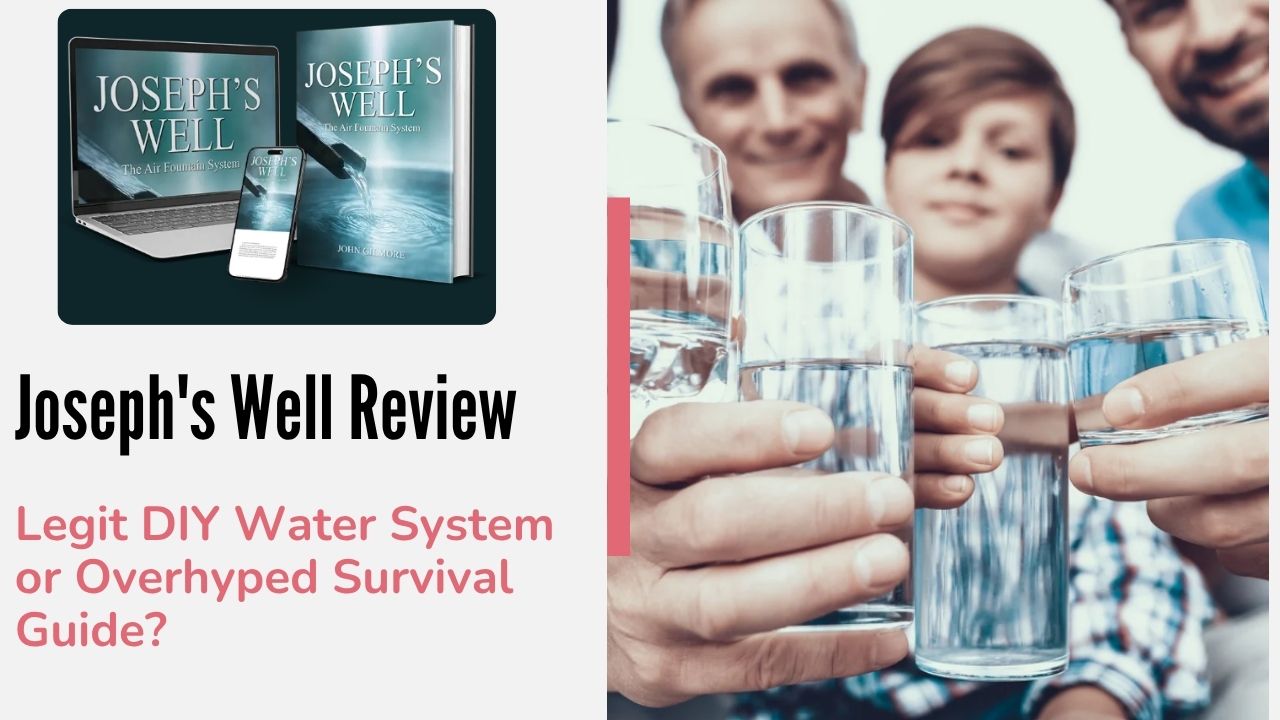
Joseph’s Well is a digital DIY guide — not a physical product — that teaches you how to build your own atmospheric water generator (AWG) at home. You get video tutorials, printable blueprints, a materials list, and several bonus guides, all delivered digitally after purchase.
The program was created by John Gilmore, described as a faith-driven father and husband who developed this system after his family’s well dried up during a severe drought. He adapted condensation-based water extraction technology — similar to what militaries use in arid field operations — into a beginner-friendly, low-budget DIY format.
It’s currently sold through Digistore24 and is priced at $39, backed by a 60-day money-back guarantee.
The Science Behind It: Can You Actually Make Water from Air?
Yes — and this is where the product gets real credibility fast.
Atmospheric water generation is an established technology. The core principle is simple: when warm humid air contacts a cool surface, moisture condenses into liquid water. It’s the same physics behind dew on morning grass, or condensation on a cold glass.
According to the U.S. Department of Energy, AWG systems are a viable supplemental water source in humid environments. Commercial units are already used in military, disaster relief, and off-grid applications worldwide.
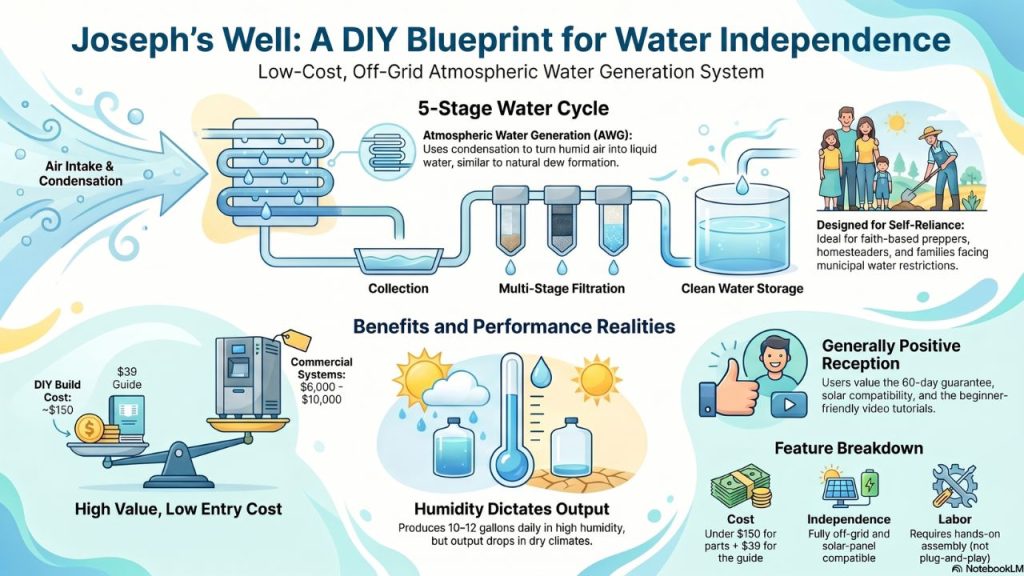
The Joseph’s Well system essentially teaches you to replicate that same process with off-the-shelf components, rather than buying a $6,000–$10,000 commercial machine.
Here’s the basic process the guide walks you through:
- Air intake — a fan draws surrounding air into the system
- Condensation — air passes over cooled surfaces, causing moisture to drop out as liquid
- Collection — water drips into a reservoir
- Filtration — water passes through a multi-stage filter
- Storage — clean water is stored and ready to use
America’s Water Problem Is Real — And Getting Worse
If you’re worried about water security, you’re not being paranoid. You’re paying attention.
The Colorado River, which supplies drinking water to roughly 40 million Americans across seven states, has been shrinking for decades. Lake Mead — the largest reservoir in the U.S. — dropped to historic lows in 2022, triggering the first-ever federal water shortage declaration.
The U.S. Drought Monitor consistently shows that over 40% of the contiguous United States experiences some level of drought at any given time. In the West, that number is often much higher.
Municipal water systems are under increasing stress. Water restrictions, rationing, and infrastructure failures are no longer hypothetical risks — they’re documented realities in cities across California, Nevada, Arizona, New Mexico, and Texas.
Against that backdrop, having an independent water source isn’t extreme. It’s practical.
What’s Included in Joseph’s Well
- Step-by-step video tutorials — Full visual walkthrough of each stage of the build
- Printable blueprints and diagrams — Lay them flat on your workbench and follow along
- Full materials list — Exact parts, estimated costs, and where to source them
- Solar integration guide — Instructions for running the system completely off-grid using a basic solar setup
- Bonus: Water Storage Guide — Best practices for safely storing and rotating your water supply
- Bonus: Purification and Mineralization Manual — How to filter and improve the quality of collected water
- Bonus: Hidden Toxins in Tap Water Report — An overview of common contaminants in municipal water systems
Everything arrives digitally, immediately after purchase. No shipping, no wait.
How Much Water Can It Actually Produce?
The official sales page claims up to 10–12 gallons per day. That number is real — but it’s the ceiling, not the average.
Realistic output depends almost entirely on relative humidity in your environment:
- High humidity (60%+): 5–10+ gallons per day is achievable — solid coverage for drinking and cooking for a family
- Moderate humidity (40–60%): 2–5 gallons per day is a more realistic estimate
- Low humidity (below 30%): Output drops significantly — possibly less than 1 gallon per day
This isn’t a flaw specific to Joseph’s Well. It’s a fundamental constraint of all AWG technology. The National Library of Medicine notes that atmospheric water harvesting is most effective in climates with relative humidity above 50%. If you live in the humid South, the Midwest, the Pacific Northwest, or the East Coast, this system could work very well for you. If you’re in a dry desert environment year-round, temper your expectations.
Who Is Joseph’s Well Best For?
Families Worried About Drought and Water Shortages
If you’re in a drought-prone region and you’ve watched your water bill rise while usage restrictions tighten, a backup water generation system might offer genuine peace of mind. This could serve as a supplemental source during restrictions rather than a complete replacement for your main supply.
Faith-Based Families and Christian Preppers
The program draws heavily from the biblical story of Joseph, who stored grain during years of abundance to sustain Egypt through seven years of famine (Genesis 41, NIV). The framing resonates with Christians who see preparedness as stewardship rather than fear — caring for your household the way Scripture calls you to. It’s one of the few survival products that speaks that language authentically.
Off-Grid Homesteaders and Self-Reliance Advocates
No utility hookup, no monthly bill, no permit required (since you’re not drilling into the ground or tapping city lines). If you’re building toward water independence on a homestead or rural property, this could be a practical, low-cost piece of that system. Combined with rainwater harvesting and a traditional well, it adds a meaningful redundancy layer.
Emergency Preparedness Families
FEMA’s official guidance recommends storing at least one gallon of water per person per day for emergency use. The problem with stockpiling is that it’s finite — you eventually run out. A generative system that keeps producing water as long as there’s humidity in the air is a fundamentally different kind of safety net than water jugs in the garage.
Joseph’s Well: Pros and Cons
| ✅ Pros | ❌ Cons |
|---|---|
| 💧 Real, proven technology — AWG is used by militaries and relief organizations worldwide | 🏜️ Output drops in dry climates — Under 30% humidity, results may be minimal |
| 💰 Low-cost entry — $39 for the guide, under $150 to build vs. $6,000+ commercial AWG units | 🔧 Requires hands-on building — Not a plug-and-play product; you assemble it yourself |
| ☀️ Runs fully off-grid — Compatible with a basic solar panel and battery setup | 📦 Digital only — No physical product shipped; some buyers expect a device, not a guide |
| 🔑 No permits needed — You’re not tapping city infrastructure or drilling; legal for personal use | ⚡ Electricity required — Unless you add solar, the fan and cooling need a power source |
| 📚 Beginner-friendly content — Video walkthroughs and printable blueprints designed for non-technical users | 🎯 Sales page is emotionally charged — Heavy use of urgency and fear-based framing |
| 🛡️ 60-day money-back guarantee — Low financial risk to try it | 📖 Guide only, no coaching — You’re on your own if something in your specific setup doesn’t go smoothly |
Is Joseph’s Well a Scam?
No — but let’s be precise about what it is and isn’t.
The core technology is legitimate. AWG units are real products used by the U.S. military in field operations and deployed in humanitarian relief efforts globally. The condensation process the guide teaches is grounded in basic physics.
The program delivers real content — not empty promises. You get blueprints, videos, and actionable instructions you can actually follow.
Most complaints I’ve seen come from two groups: people in very dry climates who expected full output regardless of humidity, and people who expected a physical machine. Neither is a flaw in the product itself — it’s a mismatch between expectation and reality.
Where I’d urge caution: the sales page leans very hard on apocalyptic framing and urgency. Take that layer with some skepticism. The underlying DIY guide, stripped of the marketing theater, is a practical, well-structured preparedness resource.
What Does It Actually Cost to Build?
- Guide price: ~$39 (one-time, digital)
- Build materials: Under $150, sourced from hardware stores or Amazon
- Optional solar setup: An additional $100–$300 depending on your existing equipment
- Ongoing costs: Minimal — primarily electricity for the fan and cooling components
- Comparable commercial AWG unit: $2,000–$10,000
From a pure cost-benefit standpoint, even if the system only partially delivers on its output claims, you’re accessing a meaningful technology for a fraction of the commercial price.
My Honest Take
Joseph’s Well is a good fit for a specific type of person: someone willing to roll up their sleeves and build something, who lives in a reasonably humid climate, and who genuinely values water independence — whether that comes from faith, a preparedness mindset, or simply watching the news.
If you’re expecting a miracle machine that solves all water problems in a desert at the press of a button, you’ll be disappointed.
But if you’re a homesteader in the Southeast, a prepper family in the Midwest, a Christian who takes Genesis 41 seriously, or a household in a drought-prone region who wants a backup water source beyond what you can stockpile — this could be a genuinely useful addition to your preparedness setup.
At $39 with a 60-day guarantee, the financial risk is about as low as it gets.
👉 Visit the Official Joseph’s Well Page
Frequently Asked Questions
Do I need construction experience to build this?
No. The guide is designed for people with zero technical background. If you can follow instructions and use basic hand tools, you should be able to work through it.
How much humidity does my area need for this to work well?
Above 50% relative humidity is the sweet spot. You can check your local average on weather.gov or through your city’s climate data.
Can I run it without connecting to the power grid?
Yes. The guide includes instructions for integrating a small solar panel and battery, which would make it fully independent from utility power.
Is it legal to build and use?
Yes, for personal use on your own property. Since you’re not tapping municipal water lines or drilling a registered well, no permit is typically required. That said, regulations vary by jurisdiction, so checking your local codes wouldn’t hurt.
What’s the refund policy?
60 days. If you’re not satisfied, you can contact support for a full refund — no questions asked, according to the official policy.
Bottom Line
This Joseph’s Well review comes down to this: it’s a legitimate, research-backed DIY program that teaches a real technology at an accessible price point. It’s not magic, and it’s not for everyone. But for the right person — in the right climate, with the right mindset — it could be a meaningful step toward genuine water independence.
👉 Check Current Price & Get Instant Access
Disclosure: This article contains affiliate links. If you purchase through our link, we may earn a small commission at no extra cost to you. We only recommend products we’ve thoroughly researched.