
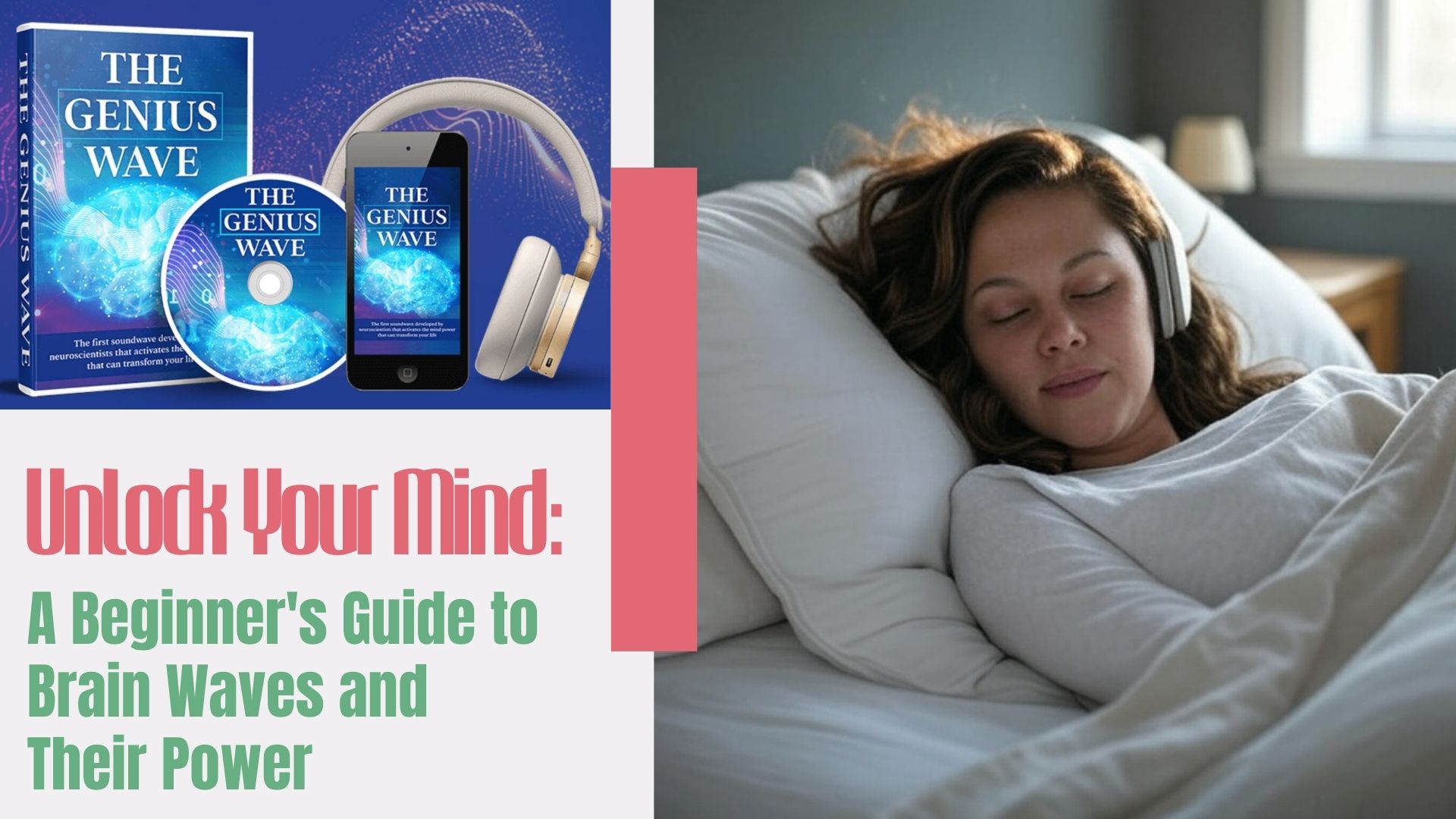
If you’re a student staring down exams, language learning goals, or technical certifications, you’ve probably heard about The Genius Wave for students. It’s marketed as a 7-minute audio track that uses theta brainwave entrainment to help with focus, memory, and “super-learning.”
But does it actually work for studying? I talks to students who’ve used it, checked the neuroscience behind theta waves, and tested the program myself. Here’s everything you need to know before trying it for your own study routine.
For the full overview of the program, check out the complete Genius Wave review.
What Is The Genius Wave (And Why Is It Touted for Students)?
The Genius Wave is a 7-minute digital audio track that uses theta brainwave entrainment technology. It’s designed to guide your brain into a theta state (4–8 Hz), which is associated with deep relaxation, creativity, and enhanced memory formation.
The program is aimed at time-poor professionals, students, and lifelong learners who want a quick, structured mental boost they can stack onto their existing routine. You don’t meditate. You don’t take pills. You just listen for 7 minutes daily with headphones.
It’s often framed around the idea of “super-learning” — making studying easier, retaining information faster, and pulling clear answers from your brain when you need them most.
Here’s what you get:
- The main 7-minute theta wave audio track (downloadable MP3/M4A)
- Bonus eBook: The Secret Behind Attracting Money and Wealth
- Bonus guided visualization: Get Genius Visualization
- Bonus infographic: Create Your Ideal Future
- 90-day money-back guarantee
If you’re curious and want to try it: Get The Genius Wave — 90-Day Guarantee
The Science: Why Theta Waves Matter for Learning & Memory
Let’s start with the actual neuroscience — because if this is going to affect your study sessions, you deserve to know what’s really going on.
What Are Theta Waves?
Your brain produces electrical activity in different frequency patterns called brainwaves. Theta waves sit in the 4–8 Hz range, right between deep sleep (delta) and calm awareness (alpha).
This is the same state your brain naturally enters during:
- Deep meditation
- Light sleep (the zone just before you wake up)
- Moments of sudden insight or “aha!” realizations
- States where you’re absorbing information without force
Theta Waves & Memory
A 2024 review published in PMC (National Institutes of Health) found that theta power increases during memory tasks, and higher theta power was consistently correlated with better memory performance.
Psychology Today also reported that theta waves play a crucial role in binding incoming sensory information into long-term memory — making them directly relevant to studying, learning new skills, and retaining complex information.
For students, this is the key point: theta states appear to be when your brain is most receptive to forming new memories.
Theta Waves & Learning
Research covered by Predicting My Future notes that theta waves create a mental environment conducive to accessing deeper levels of learning and insight.
If you’ve ever noticed you learn better after a good night’s sleep or during a relaxed state — that’s because theta is naturally elevated in those moments. The Genius Wave is essentially trying to give you that same state intentionally, on demand.
Theta Waves & Stress Reduction
Because theta sits at the border between wakefulness and sleep, it’s naturally associated with reduced anxiety, emotional regulation, and mental calm. If you’re dealing with brain fog, mental fatigue, or exam stress, theta-dominant states are generally associated with feeling calmer and less reactive.
How The Genius Wave Might Help With Studying
Here’s the practical part: how does this actually translate to studying better?
The program is designed to guide your brain into a 6 Hz theta frequency using:
- Binaural beats — two slightly different tones played separately into each ear via headphones. Your brain perceives the difference as a 6 Hz “beat” right in the theta range.
- Isochronic tones — a single tone that pulses on and off at a set rhythm. The brain follows the pulse rate and adjusts its own frequency accordingly.
According to BrainTap, both methods work on the same principle: the brain synchronizes its electrical activity with the rhythm of the auditory stimulus.
For students, this could translate to:
- Faster focus startup — less time “warming up” before you can dive into studying
- Better retention — information absorbed during or after theta sessions may stick more easily
- Reduced mental fatigue — feeling calmer and less overwhelmed during long study sessions
- Easier recall — when you’re in a relaxed theta state, retrieving what you learned might feel smoother
It’s not magic. It’s not a replacement for actual studying. But if you’re already grinding through material, this might help prime your brain to work more efficiently.
Want to try priming your brain for study sessions? Download The Genius Wave here.
What Real Students Report: Benefits & Results
I don’t just rely on marketing claims. I looked at what over 19,389 reported user experiences say about results, then filtered for student-specific feedback.
Here are the consistent benefits students report:
- Improved focus during study sessions — easier to stay on task without drifting
- Better retention of complex material — concepts feel clearer and stick longer
- Faster learning speed — needing fewer repetitions to master new information
- Reduced exam anxiety — feeling calmer before and during tests
- Better sleep quality — which indirectly improves memory and cognition
- Less brain fog — feeling mentally sharper throughout the day
Real student quotes from reviews:
- “I listen every morning before studying and feel sharper all day.”
- “I’ve been solving problems faster and coming up with answers more effortlessly during exams.”
- “This isn’t just a study tool — it’s a mindset shift. I feel less stressed about everything.”
Important note: Many users report noticing clarity or energy shifts after the first session, but better study results build over 2–4 weeks of consistent use.
How to Use The Genius Wave for Studying (Best Routine)
If you’re going to use this for studying, timing matters. Here’s the routine that works best for most students:
| Timing | Why It Works |
|---|---|
| Before your first study block (morning) | Primes your brain for focused absorption early in the day |
| Right before a difficult session (e.g., math, language) | Helps you enter a relaxed state where complex material feels easier |
| After a long study session | Helps consolidate what you learned and reduce mental fatigue |
| Before bed | Theta is close to sleep state — may improve memory consolidation overnight |
My personal recommendation: listen for 7 minutes before your main study block, then study for 60–90 minutes. Repeat this consistently for 2–3 weeks and track whether retention feels better.
Here are the basic usage rules:
- Use quality stereo headphones — earbuds work, but over-ear headphones produce a more immersive effect for binaural beats
- Listen for 7 minutes daily — no focusing or meditation required; just relax
- Stay consistent for at least 2–3 weeks — brain entrainment is more effective over repeated sessions
- Don’t use it while driving or operating machinery — the relaxation can be profound
Ready to start your study routine with this? Get The Genius Wave (80% Off Today)
Which Students Might Benefit Most?
Not every student needs this. Based on the science and user reports, The Genius Wave for students might be most useful for:
- Exam preppers — SAT, GRE, MCAT, medical boards, or any high-stakes test where retention is critical
- Language learners — vocabulary, grammar, and pronunciation require massive memory work
- Technical certification students — coding, engineering, finance, or data science material that’s dense and complex
- Students with ADHD or brain fog — who struggle with focus and need a non-pharmaceutical tool
- Anyone feeling overwhelmed — exam stress, burnout, or mental fatigue from long study sessions
It may not be the right fit if:
- You have epilepsy or a neurological condition — consult your doctor first
- You’re expecting instant IQ gains — the evidence for those specific claims is thin
- You’re unwilling to use it consistently — occasional use is unlikely to produce lasting results
The Pros & Cons: No Fluff, Just Facts
Here’s my honest breakdown for students specifically:
✅ Pros for Students
- Quick routine — only 7 minutes/day, fits into any schedule
- Non-invasive — no pills, no stimulants, no side effects for most people
- Backed by user testimonials — 19,389+ reported experiences
- Includes bonuses — eBooks and visualizations for mindset support
- 90-day guarantee — risk-free trial for students
- May reduce exam stress — theta state naturally calms anxiety
❌ Cons for Students
- Not a study replacement — you still need to actually read and practice
- Results vary — some notice effects immediately, others need 3–4 weeks
- Headphones required — binaural beats won’t work without stereo headphones
- Requires consistency — one-off use won’t produce lasting benefits
- Not for epilepsy — consult a physician if you have neurological conditions
What the Research Doesn’t Fully Confirm (Yet)
I want to be straight with you here, because a lot of reviews gloss over this part.
The neuroscience of theta waves is solid. Theta activity is genuinely linked to memory, creativity, and learning in peer-reviewed research. That part isn’t controversial.
What’s less clear is whether listening to a commercial audio product like The Genius Wave reliably produces the same theta states as those observed in lab EEG studies.
A 2019 study published on PMC found mixed results when measuring the cognitive impact of binaural beat stimulation, noting that individual responses varied considerably.
A 2025 paper in Frontiers in Behavioral Neuroscience confirmed that synchronous theta-frequency audio/visual stimulation did enhance memory recall — but again, lab conditions differ from a personal audio file.
The honest summary: the technology is real and the underlying science is promising. Whether any specific commercial product delivers results consistently is harder to verify without independent testing. The 90-day money-back guarantee is, practically speaking, your best safety net here.
Try The Genius Wave risk-free for 90 days here.
Pricing, Bonuses & Where Students Can Buy
Let’s talk money — especially important if you’re on a student budget.
The Genius Wave is a one-time purchase of $39 (digital download), which includes the main audio + all bonuses. Currently, there’s an 80% discount running.
Here’s what you get:
- Core 7-minute Genius Wave audio track
- Lifetime access to downloadable MP3/M4A files
- Bonus eBook: Money & Wealth strategies
- Bonus visualization: Get Genius Visualization
- Bonus infographic: Create Your Ideal Future
- 90-day money-back guarantee
Important: The Genius Wave is not sold on Amazon or other marketplaces. To avoid counterfeit versions, always purchase through the official website.
Grab the discount here: Get The Genius Wave at 80% Off.
FAQ: Student-Specific Questions
Q: Can I use this while I’m actually studying?
A: No — you need to listen passively for the 7 minutes. Use it before or after studying, not during.
Q: How soon will I notice better study results?
A: Many users report clarity shifts after the first session. Better retention and focus improvements build over 2–4 weeks of consistent use.
Q: Is it safe to use daily during exam season?
A: Yes. The Genius Wave is 100% non-invasive, non-addictive, and based on natural brain rhythms.
Q: Do I need expensive headphones?
A: No. Any stereo headphones work. Over-ear headphones tend to produce a more immersive effect, but earbuds are fine too.
Q: Can I use this for language learning specifically?
A: Yes — theta states are linked to memory formation, which is critical for vocabulary and grammar retention.
Final Thoughts: Should Students Try The Genius Wave in 2026?
If studying feels overwhelming, retention is weak, or exam stress is high — The Genius Wave for students might be a low-effort tool that helps prime your brain for better performance.
No pills. No stimulants. Just 7 minutes a day — and a scientifically-tuned audio track that helps your mind function at a calmer, more focused level.
For students, this might complement your existing study routine by:
- Reducing the mental friction before you start studying
- Helping information stick more easily during learning sessions
- Lowering exam anxiety so you perform closer to your actual ability
- Giving you a sense of control over your mental state
And remember: you’ve got a 90-day money-back guarantee, so there’s zero risk in testing it during your next study block or exam season.
Ready to give it a shot? Here’s the official link with the current discount: Get The Genius Wave Now (80% Off + Bonuses)
This The Genius Wave for students breakdown covered everything you need to know — from the underlying theta science to real student experiences. If you’re ready to study with better focus, retention, and less stress, this could be a useful tool in your routine.
Don’t forget: The Genius Wave is only available through the official website, not Amazon. Avoid counterfeit versions by purchasing here: Official The Genius Wave Purchase Page.
Start your student study routine with The Genius Wave here.