
A practical, research-backed guide for homesteaders, preppers, and anyone who wants water independence — without spending thousands of dollars.
Why More Americans Are Looking for Alternative Water Sources
This isn’t just a prepper concern anymore. It’s a mainstream one.
The Colorado River, which supplies water to 40 million Americans in seven states, has been shrinking for decades. In 2022, the federal government declared a water shortage on the Colorado River system for the first time in history.
According to the U.S. Drought Monitor, over 40% of the contiguous United States is in some stage of drought at any given time. Cities in California, Nevada, Texas, and Arizona have all implemented water restrictions in recent years.
The point? Relying entirely on a municipal tap or a single well is a single point of failure. Having at least one alternative water source isn’t extreme — it’s just practical planning.
The Science: How Does Air Actually Contain Water?
Even in a desert, the air around you holds moisture. This is called relative humidity — the percentage of water vapor the air is holding relative to how much it could hold at that temperature.
When that moist air contacts a cooler surface, the vapor condenses into liquid water droplets. You see this every day — dew on morning grass, condensation on a cold glass, fog rolling through a valley. Every one of those is water being pulled from air.
The methods below all exploit this same basic principle. They just do it in different ways, at different scales, and at different costs.
5 Real Methods to Make Water from Air at Home
Method 1: Fog Collector (Passive — No Electricity Needed)
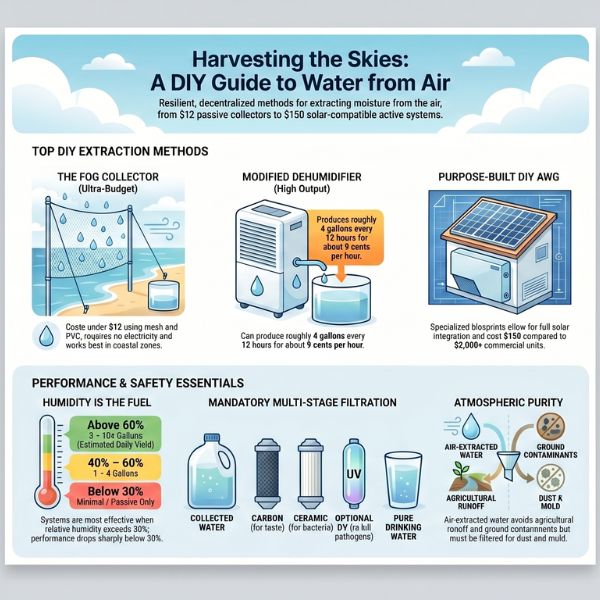
This is the oldest and cheapest method. A stretched mesh net is mounted outdoors at night. As humid air passes through the mesh, water droplets cling to the fibers, bead together, and drip down into a collection trough below.
Materials needed:
- Shade cloth mesh (35% density, 6×6 ft) — ~$5
- PVC pipe frame — ~$3
- Zip ties + plastic gutter section — ~$1–$2
- Total: under $12
Realistic output: 0.5–2 liters per night in average humidity. In coastal or fog-prone areas, up to 4+ liters per night. Scale your mesh to 10×10 ft for family-level output.
This exact method was used by villages in the Atacama Desert in Chile — one of the driest places on Earth — to supply their drinking water. If it works there, it might work anywhere with regular fog or coastal humidity.
Best for: Coastal regions, foggy climates, nighttime dew zones. Not reliable in dry inland deserts.
Method 2: Modified Dehumidifier AWG (Low-Cost, Moderate Output)
A standard household dehumidifier already extracts water from air — it just routes it into a waste tank. With a simple modification, you can reroute that output through a water filtration system and make it drinkable.
Basic parts needed:
- New dehumidifier (rinse it thoroughly before use)
- Clear vinyl tubing to bypass internal reservoir
- Multi-stage water filter (ceramic + carbon)
- Storage container
According to a documented DIY build guide, a dehumidifier-based AWG can produce around 4 gallons of water in 12 hours at a running cost of approximately 9 cents per hour. That’s meaningful daily output for a small household.
The key step is filtration. The water coming out of a dehumidifier coil is technically distilled, but it has passed through metal components and may pick up dust, mold, or contaminants. A proper multi-stage filter — at minimum carbon and ceramic — is non-negotiable before drinking.
Best for: Moderate-to-high humidity climates. Works indoors. Can run off a small solar inverter for off-grid use.
Method 3: Peltier Plate Cold Surface Collector (Ultra-Budget DIY)
A Peltier thermoelectric module is a small chip that gets extremely cold on one side when electricity passes through it. Mount one inside a box with a fan pushing humid air over the cold surface, and water condenses and drips into a collection tray below.
This method has been demonstrated for under $5 in parts. Output is small — more of a proof-of-concept than a primary water source. But it’s functional, educational, and cheap to experiment with.
Best for: Experimenting, small supplemental collection, understanding AWG principles firsthand.
Method 4: DIY Dew Trap (No Moving Parts, Free to Run)
In many climates, a simple plastic sheet or metal surface placed at the right angle outdoors at night will collect meaningful amounts of dew by morning. The surface cools overnight, reaches the local dew point, and moisture precipitates out of the air onto it.
The Negev Desert researchers have studied and documented passive dew collection as a legitimate supplemental water source for off-grid and rural applications. It’s not a primary solution, but as a passive, zero-cost backup — it’s hard to beat.
Best for: Clear-sky, high-humidity nights. Works best in river valleys and coastal zones.
Method 5: Purpose-Built DIY Atmospheric Water Generator Blueprint
If you want a comprehensive, purpose-designed system rather than piecing together components, a structured DIY guide walks you through building a complete AWG unit — including the housing, coil system, fan, filtration stages, and optional solar integration.
This is the approach taken by programs like Joseph’s Well, which I’ve reviewed in depth here: my full Joseph’s Well review. The guide covers every component, the exact materials list, and how to integrate solar power so the whole system runs off-grid.
Build cost for a complete purpose-built AWG runs under $150 — compared to $2,000–$10,000 for commercial units that do the same thing.
👉 See the Joseph’s Well DIY Blueprint
How Much Water Can You Realistically Produce?
This is the most important question — and the answer depends almost entirely on relative humidity in your area.
- Above 60% humidity: A properly built dehumidifier-based AWG could yield 3–10+ gallons per day
- 40–60% humidity: Expect 1–4 gallons per day with an active system
- Below 30% humidity: Output drops significantly; passive methods may produce less than 1 liter per night
You can check your region’s average relative humidity at weather.gov or through NOAA’s climate data portal.
Research published in the National Library of Medicine confirms that atmospheric water harvesting is most effective when relative humidity exceeds 50%. If you’re in the humid South, Pacific Northwest, Midwest, or East Coast, the numbers work in your favor.
Pros and Cons of Making Water from Air at Home
| ✅ Pros | ❌ Cons |
|---|---|
| 💧 Generates water continuously — no fixed supply that runs out | 🏜️ Humidity-dependent — output drops sharply in dry climates |
| ☀️ Solar-compatible — active systems can run entirely off-grid | ⚡ Active systems need electricity — unless solar is added |
| 💰 Low build cost — DIY options range from $12 to $150, vs. $2,000–$10,000 commercial units | 🔧 Requires a build process — passive methods are simple; active AWGs take more effort |
| 🔑 No permits or utility hookup needed — fully independent water source | 🧪 Filtration is mandatory — raw condensate may contain airborne contaminants |
| 🛡️ Works as emergency backup — keeps producing water during droughts, restrictions, or infrastructure failures | 📦 Not a full household replacement — most DIY builds are supplemental, not primary supply |
Is the Water Safe to Drink?
Atmospheric water — water condensed directly from air — has no ground contact, no agricultural runoff, and no chemical treatment history. In that sense, it starts out quite clean.
The concern is what it picks up during collection: dust, mold spores, or metal residue from the condenser components. This is why filtration is not optional.
A proper setup should include:
- Pre-filter: Removes dust and airborne particles before collection
- Carbon filter: Removes organic compounds and improves taste
- Ceramic or 1-micron filter: Removes bacteria and protozoa
- UV sterilization (optional but recommended): Kills any remaining pathogens
- Remineralization (optional): Adds back trace minerals for better taste and health
A documented build from the UK reported sending collected water to a lab for testing — and it met all potable drinking standards after filtration.
Who This Approach Is Best For
Off-Grid Homesteaders
If you’re building toward water independence, an AWG fills the gap on days when rain isn’t falling and your well isn’t pulling enough. It’s a no-permit, no-utility supplemental source that runs on electricity or solar.
Emergency Preparedness Families
FEMA recommends storing one gallon per person per day for emergencies. The problem with stockpiling is it runs out. A generative water source keeps producing as long as there’s moisture in the air around you — which is a very different kind of security than a shelf of water jugs.
Faith-Based Families Thinking Long-Term
There’s a reason this resonates with so many Christians who take stewardship seriously. Being prepared to care for your household — your family, your neighbors — is an act of responsibility, not fear. Learning to generate your own water from the air might be one of the most practical things you can do right now. As the story of Joseph in Genesis 41 (NIV) illustrates, preparation during times of abundance protects you and those around you when scarcity arrives.
Drought-Affected Households
If you’re in a state that’s seen water restrictions, mandatory rationing, or well failures in recent years — a backup atmospheric water system might not be a luxury. It might just be smart timing.
👉 See the Complete DIY Water Blueprint
How to Choose the Right Method for You
Here’s a quick decision guide based on your situation:
- Zero budget, high humidity or coastal area? → Start with a fog collector. $12, no electricity, passive operation.
- Small budget, indoor use? → Modify a dehumidifier. Produces gallons per day with proper filtration.
- Want a complete, optimized DIY system? → Use a structured guide that covers everything — housing, coil design, solar integration, and multi-stage filtration in one package. My full review of Joseph’s Well covers this in detail.
- Live in a very dry desert climate? → Atmospheric methods may underperform. Rainwater harvesting or well augmentation might be more reliable for your region.
Final Thoughts
Learning how to make water from air at home isn’t about living off the grid or preparing for apocalyptic scenarios. It’s about building one more layer of resilience into your household — the kind of quiet preparedness that makes a real difference when municipal systems fail, when droughts tighten water restrictions, or when you simply want to depend a little less on systems outside your control.
The technology is real, the methods are proven, and the cost barrier is lower than most people expect. Whether you start with a $12 fog net or a full DIY AWG blueprint, any step toward water independence is a worthwhile one.
👉 Get the Joseph’s Well DIY Blueprint — See Current Price
Disclosure: This article contains affiliate links. If you purchase through our link, we may earn a small commission at no extra cost to you.