
A practical, no-nonsense guide to building your own air-to-water system — for homesteaders, preppers, and anyone tired of depending on a water supply they can’t control.
What Is an Atmospheric Water Generator?
An atmospheric water generator (AWG) is any device that extracts moisture from ambient air and converts it into drinkable water.
The core principle is condensation: cool a surface below the local dew point, and water vapor in the air will naturally precipitate onto that surface as liquid droplets.
Commercial AWG units — sold by companies like Zero Mass Water and EcoloBlue — cost anywhere from $2,000 to $10,000. A well-built DIY version uses the same physics for a fraction of that cost.
Why Build One Right Now?
Here’s the situation in America right now: the Colorado River — the water source for 40 million Americans — has been shrinking for decades. The first-ever federal water shortage was declared on it in 2022.
The U.S. Drought Monitor consistently shows more than 40% of the continental United States in some form of drought. Water restrictions are becoming common in states like California, Nevada, Texas, and Arizona.
If your only water source is a municipal tap, you have exactly one point of failure. An atmospheric water generator could give you a second one — and that might matter more than you expect.
👉 See a Complete DIY AWG Blueprint (Joseph’s Well)
How a DIY Atmospheric Water Generator Works
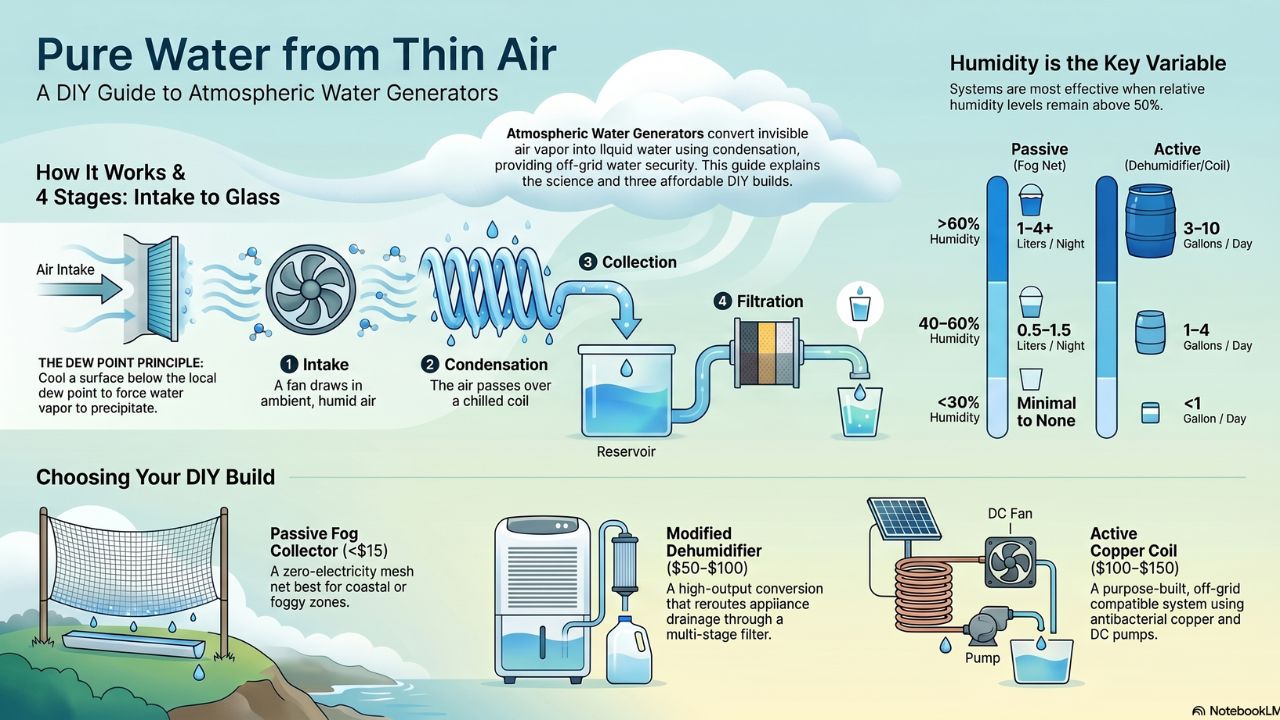
Every AWG build — no matter how simple or complex — follows the same four-stage process:
- Air intake — Humid air is drawn into or across the system (via a fan or natural airflow)
- Condensation — Air contacts a cooled surface (coil, plate, or mesh) and water vapor drops out as liquid
- Collection — Liquid water drips into a reservoir or tray below the cold surface
- Filtration — Water passes through a filter system to remove contaminants before drinking
The difference between a $12 fog net and a $150 full AWG build is mostly in how you create the cold surface — passively (using nighttime temperature drops) or actively (using a cooling coil powered by electricity or solar).
3 DIY Atmospheric Water Generator Builds (Easiest to Most Advanced)
Build 1: Passive Fog Collector — Under $15, Zero Electricity
This is the entry point. No moving parts, no electricity, no technical skills required.
A mesh net strung between two poles collects fog and dew as humid air passes through it overnight. Water droplets cling to the fibers, bead together, and drip into a collection trough. The same method was historically used by communities in the Atacama Desert — one of the driest places on Earth — to supply village drinking water.
Materials:
- Shade cloth mesh (35% density, 6×6 ft) — ~$5
- PVC pipe frame (four 3–4 ft sections) — ~$3
- Zip ties — ~$1
- Plastic gutter section as collection trough — ~$3
- Total: ~$12
Realistic output:
- Average humidity (50–60%): 0.5–1 liter per night
- Coastal or foggy zones: 2–4 liters per night
- Scale to 10×10 ft mesh for family-level output
Best for: Coastal and fog-prone areas. Very dry inland climates will see minimal results.
Build 2: Modified Dehumidifier AWG — $50–$100, Moderate-High Output
A standard dehumidifier already extracts water from air — it just dumps it into a waste tank. Reroute that output through a drinking water filtration system and you have a functional AWG.
According to a documented DIY build guide, a dehumidifier-based AWG can produce around 4 gallons of water in 12 hours at about 9 cents per hour in electricity.
Step-by-step:
- Buy a new dehumidifier and rinse the interior thoroughly with a garden hose — don’t use high pressure
- Remove the internal water tank and run clear vinyl tubing from the drainage port to your filter system
- Install an upgraded air pre-filter on the intake (cut 3M scrubber pads to fit — original filters miss too much dust)
- Route the tubing into a multi-stage filter — at minimum a 1-micron ceramic filter plus a 5-stage carbon filter
- Run the unit for 6–8 hours to fill the upper filter chamber before drinking
Important: Never skip filtration. The condensate coming off metal coils may carry trace aluminum, copper, dust, or mold spores. A proper multi-stage filter makes it safe. This build on Instructables adds a UV sterilizer and remineralization stage — a smart upgrade if you plan to drink this as your primary water source.
Best for: Humid climates, indoor use, households with access to grid or solar power.
Build 3: Copper Coil Active AWG — $100–$150, Purpose-Built
This is the full version — purpose-designed for water generation rather than adapted from a dehumidifier. Cold water is pumped through copper coils using a small submersible pump. The coils chill rapidly, air contacts them, and condensation drips into a collection pan below.
Core components:
- ¼-inch copper tubing (coiled around a form like a soup can) — naturally antibacterial
- ½-inch PVC pipe framework for housing
- 12V DC submersible water pump to circulate cold water through the coil
- Aluminum collection tray below the coil
- Clear vinyl tubing connecting components
- Multi-stage drinking water filter on the output
- Optional: small 12V fan to push more humid air across the coil
This is the type of build covered in comprehensive DIY programs like Joseph’s Well, which walks you through each component, provides printed schematics, and includes solar integration instructions so the entire unit can run off-grid. If you’d rather follow a tested, step-by-step blueprint than piece one together from scratch, that might be worth a look.
Best for: Homesteaders, serious preppers, off-grid builds, anyone who wants a purpose-designed system rather than an adapted appliance.
Filtration: The Step You Can’t Skip
Condensed atmospheric water starts out cleaner than most tap water — no ground contact, no agricultural runoff, no chlorine. But it picks up contaminants during collection through metal components and airborne dust.
Here’s a filtration stack from basic to comprehensive:
- 🔵 Pre-filter (mandatory): Removes airborne dust and particles before they enter the system
- 🔵 1-micron ceramic filter (mandatory): Blocks bacteria, protozoa, and sediment
- 🔵 Activated carbon filter (mandatory): Removes organic compounds and improves taste
- 🟡 UV sterilizer (recommended): Kills any remaining pathogens — especially important if coils aren’t cleaned regularly
- 🟡 Remineralization stage (optional): Adds trace minerals back to distilled-quality water — ½ tsp of Himalayan salt per gallon is a common DIY approach
A documented real-world build sent output water to a lab for testing and received confirmation that it met all potable drinking standards after filtration. That’s the level of rigor you should aim for.
How Much Water Can Your Build Actually Produce?
Humidity is the single biggest variable. Here’s a realistic reference table:
| Relative Humidity | Passive (Fog Net) | Active AWG (Dehumidifier/Coil) |
|---|---|---|
| Above 60% | 1–4+ liters/night | 3–10 gallons/day |
| 40–60% | 0.5–1.5 liters/night | 1–4 gallons/day |
| Below 30% | Minimal to none | Under 1 gallon/day |
Check your local average relative humidity at weather.gov before deciding which build makes sense for your region.
Research published in the National Library of Medicine confirms that atmospheric water harvesting is most effective above 50% relative humidity. If you’re in the South, Midwest, East Coast, or Pacific Northwest — you’re well-positioned.
Can You Run It Completely Off-Grid?
Yes — and this is where it gets interesting for homesteaders and preppers.
The dehumidifier or pump motor in an active AWG typically draws 150–300 watts. A basic solar panel and battery setup can power that continuously. Many off-grid builds use:
- A 200W solar panel (~$80–$120)
- A 12V LiFePO4 battery with 50–100Ah capacity (~$100–$200)
- A small inverter or direct 12V connection
This means the system keeps generating water even when the grid is down, water mains are cut, or municipal supply is restricted — exactly the scenario many preparedness-minded families are planning around.
👉 Get the Full Off-Grid AWG Blueprint Here
Common Mistakes to Avoid
- Skipping the pre-filter: Dust buildup on coils drastically reduces output over time and introduces contaminants
- Using plastic components near the condensate: Opt for copper and food-grade materials wherever possible — metal coils produce cleaner water than plastic ones
- Not cleaning coils regularly: Mold can grow on damp coil surfaces. A monthly rinse with diluted white vinegar keeps the system clean
- Overestimating output in low-humidity zones: Check local humidity data before planning your build around a specific output number
- Drinking unfiltered condensate: Even if it looks clean, always run it through a proper filtration stage before drinking
- Forgetting remineralization: Distilled-quality water tastes flat and long-term consumption without minerals can be suboptimal — add minerals back in
Is a DIY AWG Worth It?
That depends on your situation.
If you’re in a humid region, have basic DIY skills, and want a supplemental or emergency water source that doesn’t depend on any external system — a DIY atmospheric water generator could be a genuinely useful addition to your household setup.
If you’re in an extremely dry desert climate or have no interest in a hands-on build, this technology may underperform your expectations.
For those who want a structured path — schematics, materials list, solar integration instructions, and filtration guidance in one place — my detailed breakdown of Joseph’s Well’s DIY blueprint program covers one of the better-organized options I’ve come across at an accessible price point.
Frequently Asked Questions
Does a DIY atmospheric water generator really produce drinkable water?
Yes — if properly filtered. Raw condensate from metal coils needs to pass through at minimum a ceramic and carbon filter. After that, it’s clean by most potable water standards.
What humidity level do I need for this to work well?
Above 50% relative humidity is the practical threshold for meaningful output from an active AWG. Below 30%, output becomes too low to be a reliable water source.
Can I build one if I’ve never done a DIY project before?
The passive fog collector (Build 1) requires no skills at all. The modified dehumidifier (Build 2) is manageable for most people. The copper coil build (Build 3) needs basic plumbing skills — cutting tubing, connecting fittings. Following a step-by-step guide with schematics helps significantly.
How is this different from a regular dehumidifier?
A standard dehumidifier routes collected water to waste. An AWG routes it through a food-safe filtration system to make it drinkable. The condensation mechanism is identical — the output path is what changes.
Final Thoughts
Building a DIY atmospheric water generator is one of the more practical things you can do if water security is a real concern in your life — whether that’s driven by drought, grid vulnerability, faith-based preparedness, or just the responsible instinct to not rely entirely on systems you can’t control.
The technology works. The cost is accessible. And the skills required range from nearly zero (fog collector) to moderate (copper coil AWG).
Start with the method that fits your climate and budget. Build something. Test it. Refine it. Even a small supplemental water source is more than you had before.
👉 See the Complete Joseph’s Well DIY Blueprint
Disclosure: This article contains affiliate links. If you purchase through our link, we may earn a small commission at no extra cost to you.