
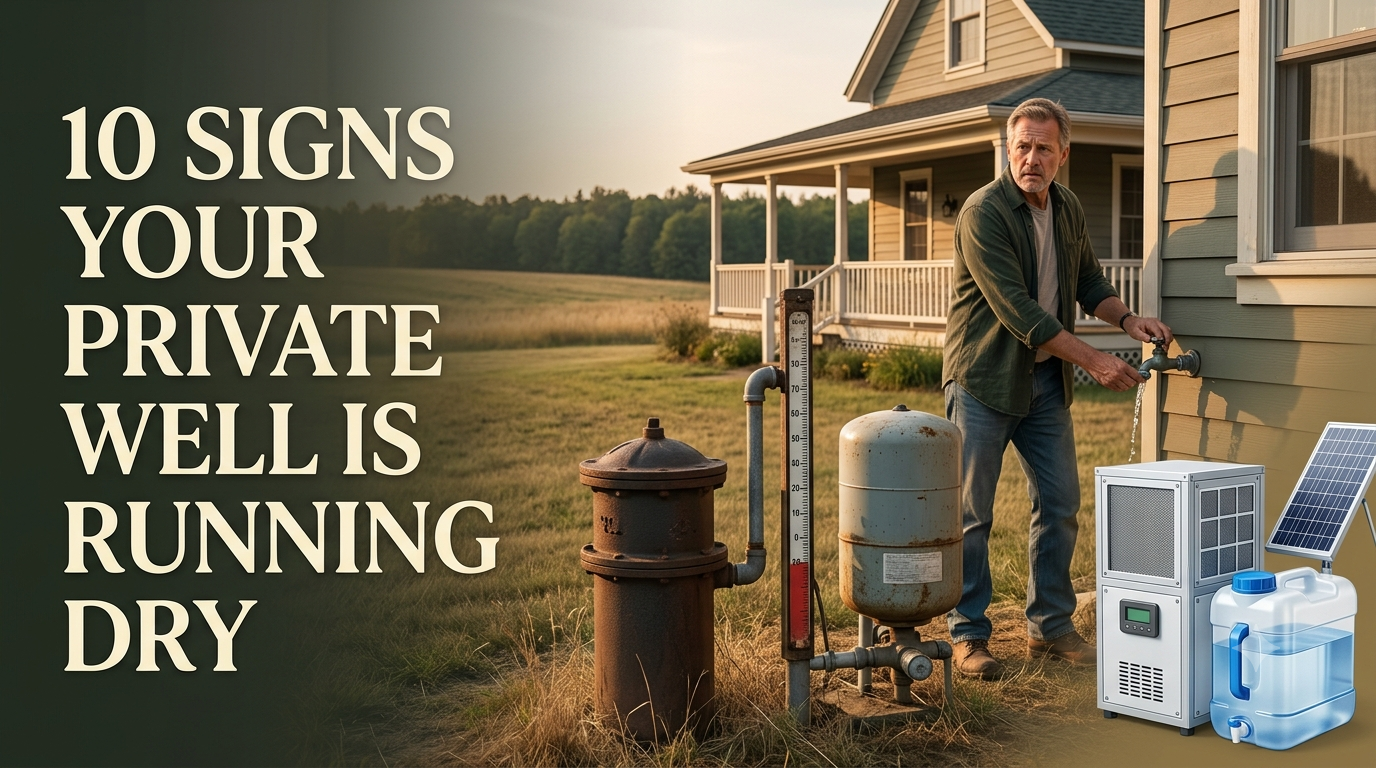
Most private wells do not announce trouble with a big dramatic warning. Usually, the first clues are annoyingly small: a shower that loses pressure, a faucet that spits air, a pump that seems to run forever, or water that suddenly looks cloudy.
That is why knowing the signs your well is running dry matters. A low-yield well, failing pump, clogged filter, broken pressure tank, drought-related groundwater decline, and plumbing leak can all look similar at first.
I have learned that the worst thing you can do is shrug off a new water-pressure problem for weeks. Sometimes it is a simple repair. Sometimes it is the first sign that your household water source needs serious attention.
This guide covers 10 warning signs, the difference between a dry well and pump trouble, what to do immediately, and how to build a sensible backup plan before your taps stop running.
1. Your Water Pressure Drops Suddenly or Keeps Changing
Low water pressure is one of the most common signs your well is running dry, but it is not proof by itself. It can also be caused by a clogged sediment filter, failing pressure switch, worn pump, leaking pipe, partially closed valve, or pressure-tank problem.
The key is change. If your shower used to have steady pressure and now fades while someone is washing dishes, that is worth checking.
A low water table can make it harder for the pump to keep up with household demand. The result may be water pressure that starts normally, then drops after several minutes of use.
The National Ground Water Association’s WellOwner resources notes that private well systems include multiple components, including the well, pump, pressure tank, and plumbing. A pressure problem can come from any one of these parts, so do not jump straight to “the well is dead.”
- Pressure drops during showers, laundry, or irrigation use.
- Water flow weakens after a few minutes of continuous use.
- One faucet may work normally while several fixtures cause pressure loss.
- Pressure rises and falls more than it used to.
- Water flow becomes noticeably weaker during dry weather.
Start simple. Check whether the issue affects every faucet or only one. If it is only one fixture, the problem may be a clogged aerator or local plumbing issue.
If the whole house is affected, look at your pressure gauge and listen to how often the pump cycles. Then call a qualified well or pump professional before changing settings or pulling equipment yourself.
2. Your Faucets Spit Air or Sputter Water
Air sputtering from faucets can be one of the more unsettling private-well warning signs. You turn on the tap, hear a cough-cough sound, and the water comes out in bursts.
Sometimes this happens because air has entered the plumbing after maintenance or a temporary power outage. But if it keeps happening, especially alongside low pressure, it may indicate the pump is pulling in air because the water level is too low.
A well pump needs enough water around it to deliver a steady flow. If the water level falls below the pump intake or the well yield cannot keep up with demand, air and water may mix in the system.
- Faucets make a sputtering or coughing sound.
- Water comes out in bursts instead of a smooth stream.
- Air appears after long showers, irrigation, or multiple appliances running.
- The problem becomes worse during hot, dry months.
- Low pressure happens at the same time as sputtering.
Do not ignore repeated air sputtering. It may not mean the well is fully dry, but it can be a clue that your system is struggling to maintain water supply.
Before assuming groundwater depletion, check for plumbing leaks and ask a professional to inspect the pump, drop pipe, well casing, and pressure system. A loose fitting or failing check valve can also allow air into the line.
One mistake people make is continuing to run large water loads while the system is sputtering. Avoid running irrigation, washing machines, and long showers until you know what is happening. You do not want to overwork a pump that may already be stressed.
3. The Well Pump Runs Constantly or Cycles Too Often
A well pump that never seems to stop is another sign worth investigating. In a healthy system, the pump turns on when pressure falls to a set level and turns off after the pressure tank is refilled.
If the pump keeps running but pressure does not build, the cause could be low well yield, a leak in the drop pipe, a worn pump, a bad pressure switch, or a depleted water level.
Short cycling is the opposite pattern. The pump turns on and off rapidly, sometimes every few seconds or minutes, often because the pressure tank has lost its air charge or the internal bladder has failed.
Both patterns can be hard on a pump. And pumps are not cheap, so this is one of those “deal with it now” problems.
- The pump runs for a long time after water use stops.
- The pressure gauge does not reach its normal shutoff level.
- The pump starts and stops rapidly or repeatedly.
- You hear clicking from the pressure switch more often than usual.
- Your electric bill rises without another obvious reason.
The U.S. Environmental Protection Agency’s private-well guidance recommends regular well maintenance and checking system components. The pump, pressure tank, and plumbing all need attention, not just the borehole itself.
If you suspect the pump is running dry, turn off high-demand water use and contact a well professional. A pump can overheat or be damaged if it runs without enough water, depending on the system design.
Do not keep resetting breakers or pressure switches hoping it will “catch up.” That can turn a manageable service call into a pump replacement.
4. Your Water Turns Cloudy, Muddy, or Full of Sediment

Cloudy, sandy, muddy, or gritty water can be a warning sign, especially if the change is new. When water levels drop, the pump may pull water from lower in the well or disturb sediment near the bottom.
That does not always mean the well is running dry. A damaged well screen, failing pump, recent flooding, plumbing work, or a cracked casing can also introduce sediment.
Still, sudden sediment deserves attention. It can clog appliances, damage faucets, wear out filters, and signal a change in your groundwater conditions.
The CDC recommends private well testing when you notice changes in water quality, including changes in taste, color, odor, or appearance.
- Water looks cloudy or brown after being clear for years.
- Sand or grit appears in sinks, tubs, toilet tanks, or appliance filters.
- Filters clog more quickly than normal.
- Water stains suddenly change color or become worse.
- Water quality changes after drought, flooding, or heavy pumping.
If you see sediment, avoid assuming it is harmless. It may just be mineral particles, but it can also point to a well-construction issue or contamination risk.
Collect a water sample and contact a local certified lab or well contractor. If there is visible dirt, a new odor, or unusual taste, use a safe alternate drinking-water source until the water has been checked.
5. You Notice New Tastes, Odors, or Water Color Changes

A change in water taste, smell, or color is not a reliable way to diagnose a dry well, but it is a reason to investigate. Groundwater chemistry can shift when the water table changes, pumping patterns change, or a well starts drawing from a different part of the aquifer.
Iron can create reddish or orange staining. Manganese may cause dark staining. Sulfur-related issues can create a rotten-egg odor. But odors can also come from drains, water heaters, bacteria, or plumbing rather than the well itself.
I mention this because it is easy to blame the well for everything. Sometimes the culprit is a water heater anode rod or a dirty drain trap. Still, changes should not be ignored.
- Water develops a metallic, earthy, salty, or sulfur-like taste.
- Water has a rotten-egg, musty, chemical, or sewage-like smell.
- Clear water becomes yellow, brown, orange, gray, or black.
- Stains on fixtures suddenly become more noticeable.
- Only hot water smells or tastes different, suggesting a water-heater issue.
The EPA advises private well owners to test water after flooding and whenever there is a change in taste, odor, color, or clarity. You cannot tell whether water is safe by looking at it, and you definitely cannot tell from one sniff.
Use a certified local laboratory for the right test panel. Ask about bacteria, nitrates, pH, total dissolved solids, iron, manganese, arsenic, or other contaminants common to your region.
6. Your Well Takes Longer to Recover After Heavy Water Use

Well recovery rate means how quickly groundwater flows back into the well after water is pumped out. A healthy high-yield well may recover quickly. A low-yield well may need time to refill after household demand.
If you used to run the washing machine, shower, and dishwasher without trouble but now the water pressure collapses after one long shower, your well may not be recovering fast enough for current use.
This can happen when groundwater levels decline, but it can also happen when household demand increases. A growing family, a new irrigation system, livestock watering, a swimming pool, or a leaky toilet can push an older well system beyond its normal capacity.
- Water pressure drops after extended use but returns later.
- The well seems fine in the morning but struggles by evening.
- Multiple water uses cause an outage or weak flow.
- The problem is worse during drought or irrigation season.
- Water supply improves after the system rests for several hours.
This is where water-use tracking can help. For a few days, write down when pressure drops and what appliances or fixtures were running.
It sounds old-school, but the pattern can help a contractor decide whether you have a well-yield problem, an undersized pressure tank, a pump issue, or a plumbing leak.
Try spacing out major water uses until the system is evaluated. Run laundry at a different time from showers. Pause irrigation. Fix known leaks right away. Small changes can take a surprising amount of strain off a marginal well.
7. Your Water Supply Fails During Drought or Hot Weather
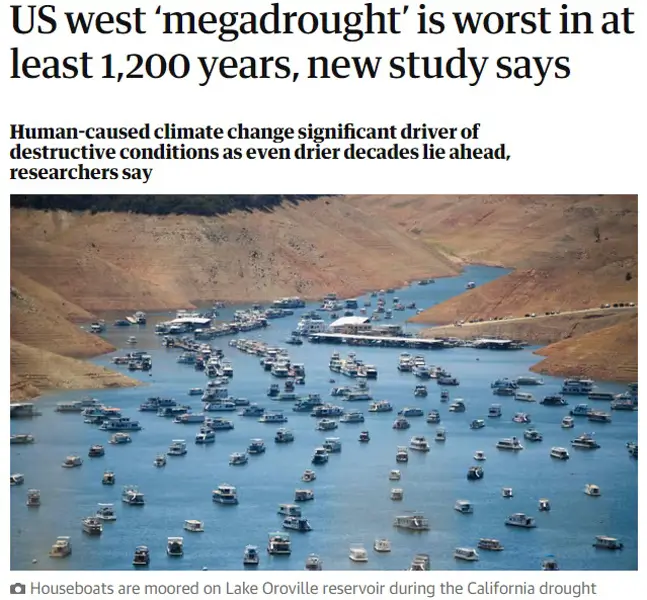
If your private well works normally most of the year but struggles during a long dry spell, that is a meaningful clue. Drought can lower groundwater levels and increase demand from irrigation, nearby wells, livestock, and households.
Not every dry summer means your well is permanently failing. But seasonal water loss tells you the system may have less margin than you thought.
The U.S. Geological Survey explains that groundwater levels can decline when withdrawals exceed recharge. Drought limits the precipitation that would otherwise help replenish groundwater over time.
- Water pressure problems appear only during long dry periods.
- Nearby neighbors report well issues at the same time.
- Outdoor irrigation makes the household water supply worse.
- Water quality changes during drought conditions.
- Your well recovers after heavy rainfall or cooler weather.
Check with neighbors and your local groundwater district if you can. If several nearby wells are acting up, it may point to a broader groundwater issue rather than one broken pump.
That said, do not wait for regional proof before protecting your own system. Reduce outdoor use, repair leaks, store emergency water, and get your well evaluated while you still have water coming from the tap.
8. Your Neighbors’ Wells Are Failing or Being Deepened
Your neighbors’ well problems are not proof that your well will fail next week. But they are definitely a reason to pay attention.
Wells in the same neighborhood may draw from similar groundwater conditions, especially if they are similar depths and located in the same aquifer. If several nearby property owners are lowering pumps, deepening wells, drilling replacements, or hauling water, it may signal groundwater stress.
Talking with neighbors can sometimes reveal more than a generic online map. People remember when their pump depth changed, when the well used to recover faster, and what drought years caused trouble.
- Nearby homes report weak water pressure or dry wells.
- Local drillers are busy deepening or replacing wells.
- Neighbors have lowered pump settings or added storage tanks.
- Local groundwater reports show declining water levels.
- New high-demand uses, such as irrigation or development, appear nearby.
Use that information as a prompt to gather facts, not to panic. Your well depth, pump setting, casing, geology, and household water use may be different.
A well contractor can measure static water level, pumping water level, recovery rate, and well yield. Those numbers are much more useful than guessing based on somebody’s Facebook post.
9. You See a Sudden Increase in Power Bills or Pump Repairs
A well pump uses electricity every time it moves water. If the pump has to run longer because the water level is lower, the system leaks, pressure is unstable, or the pump is losing efficiency, your electric bill may creep upward.
That does not mean every higher power bill is a dry-well warning. Seasonal heating and cooling, a new appliance, rate changes, or an old refrigerator can also be the reason.
But when higher electricity use appears with low pressure, longer pump run time, sputtering faucets, or repeated service calls, it becomes a stronger clue.
- Your electricity use rises with no obvious explanation.
- The pump needs repeated repairs or replacement parts.
- The pump runs longer to restore pressure.
- The pressure switch clicks frequently.
- You hear unusual humming, clicking, or grinding near the well equipment.
Keep service records. Write down pump repairs, filter changes, pressure readings, water-quality tests, and anything unusual.
It may feel like overkill, but these notes can help a professional spot a trend. A well problem that looks random over two years can become obvious when you see it all written down.
10. The Water Stops Completely or the Pump Trips Off
No water at all is the most obvious sign that something is wrong. But even then, it does not automatically mean the well has run dry.
A total water outage can be caused by a tripped breaker, failed pressure switch, broken wire, burned-out pump motor, collapsed pipe, frozen line, empty pressure tank, or an actual low-water condition.
First, check the obvious safe items: electrical power, breaker position, pressure gauge, and whether the problem affects every fixture. Do not open electrical controls or attempt to pull a submersible pump unless you are trained and equipped for it.
- No water comes from any faucet or fixture.
- The pressure gauge reads near zero.
- The well breaker trips repeatedly.
- The pump runs but no pressure builds.
- Water briefly returns after resting, then stops again.
If the pump is suspected of running dry, reduce demand immediately and call a licensed well or pump professional. Continuing to force the system can damage equipment.
Keep a few gallons of emergency water on hand so a one-day repair does not become a family crisis. This is boring advice, but boring advice is often the stuff that saves you the most stress.
What to Do If You Think Your Well Is Running Dry
If you notice several signs your well is running dry, act early. Your goal is to protect the pump, confirm the real cause, preserve the water you still have, and build a backup plan.
Do not immediately assume you need a brand-new well. A professional assessment may find a clogged filter, failed pressure tank, leaky pipe, bad pump, or another repairable issue.
- Reduce high-demand water use, including irrigation and unnecessary laundry.
- Check pressure gauges, filters, and obvious leaks.
- Schedule a well-yield, pump, and pressure-system evaluation.
- Test water quality if appearance, odor, or taste has changed.
- Contact your local health department or water agency for local guidance.
- Store drinking water while repairs or testing are underway.
- Ask the contractor about static water level, drawdown, recovery rate, and pump depth.
The CDC recommends storing at least one gallon of water per person per day for at least three days for emergencies. More may be needed in hot weather or for children, pets, older adults, and medical needs.
For a private well owner, I would go beyond the bare minimum if possible. A pump repair or water test can take longer than you expect, especially in a drought when well contractors are booked solid.
Build a Water Backup Plan Before Your Well Fails

A healthy private well is valuable, but it should not be your only water plan. Pumps need electricity. Equipment wears out. Drought happens. Water quality can change.
A layered backup plan gives you more choices when something goes wrong. Start with stored drinking water, then consider filters, treatment options, water-storage containers, legal rainwater harvesting, and other supplemental sources that fit your climate and property.
- Store emergency drinking water in sanitized, food-grade containers.
- Keep a quality water filter and a verified treatment option available.
- Learn how to shut off and protect your well system during repairs.
- Check local laws before installing rainwater or large water-storage systems.
- Maintain your pressure tank, pump controls, and well cap.
- Consider a supplemental water source suited to your local climate.
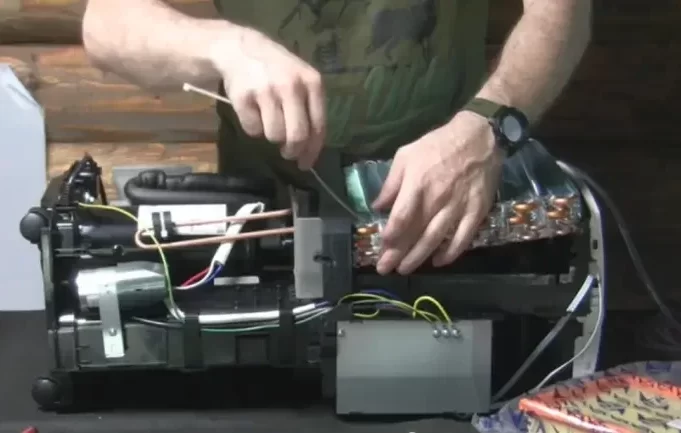
Some households research atmospheric water generators as an additional backup source. These systems collect moisture from air through condensation, so their performance depends heavily on local humidity, temperature, power use, maintenance, and water treatment.
Joseph’s Well is marketed as a DIY atmospheric-water-generator guide with plans, materials sourcing, and power options. Treat its output and cost statements as vendor claims that can vary by location and build quality.
You can read the Joseph’s Well review to understand what is offered and whether a water-from-air project makes sense as one small part of your preparedness plan.
Can an Atmospheric Water Generator Replace a Private Well?

For most homes, an atmospheric water generator should not be expected to replace a productive private well. A functioning well can supply far more household water when groundwater conditions and equipment are good.
An atmospheric water generator collects moisture from the air, which means it is strongly affected by humidity and temperature. In dry climates, production can be much lower than people expect.
Still, it may have a place as a supplemental system for drinking-water backup, off-grid experimentation, or emergency preparedness. The key word is supplemental.
The EPA’s atmospheric water generation technical brief notes that generated water requires appropriate treatment and microbial monitoring before it is used for drinking.
- Check humidity and dew-point conditions before considering a water-from-air system.
- Plan for electricity or properly sized solar-and-battery power.
- Use food-safe materials, covered storage, filtration, and disinfection.
- Test water before relying on it for drinking or cooking.
- Keep stored water even if you add an atmospheric water system.
If you want to look at the product details, you can view the Joseph’s Well DIY guide here. Compare it with your climate, household needs, and local water conditions before buying.
Conclusion: Pay Attention to Small Changes Before They Become Big Problems
The signs your well is running dry can overlap with common pump, plumbing, pressure-tank, and water-quality problems. That is why early action matters more than guessing.
Watch for falling pressure, sputtering faucets, long pump run times, sediment, water-quality changes, slow recovery after heavy use, and drought-season trouble. Then get real measurements from a qualified professional.
A private well can be a dependable water source for years. But no well is maintenance-free, and every household benefits from stored water and a basic backup plan.
Do not wait until the faucet is completely dry. A little attention now can save a lot of money, stress, and rushed decisions later.
Sources and Further Reading
- National Ground Water Association: WellOwner Resources
- U.S. Environmental Protection Agency: Private Well Guidance
- Centers for Disease Control and Prevention: Testing Private Well Water
- U.S. Geological Survey: Groundwater Decline and Depletion
- Centers for Disease Control and Prevention: Emergency Water Supply
- U.S. Environmental Protection Agency: Atmospheric Water Generation Technical Brief
- Joseph’s Well Review