
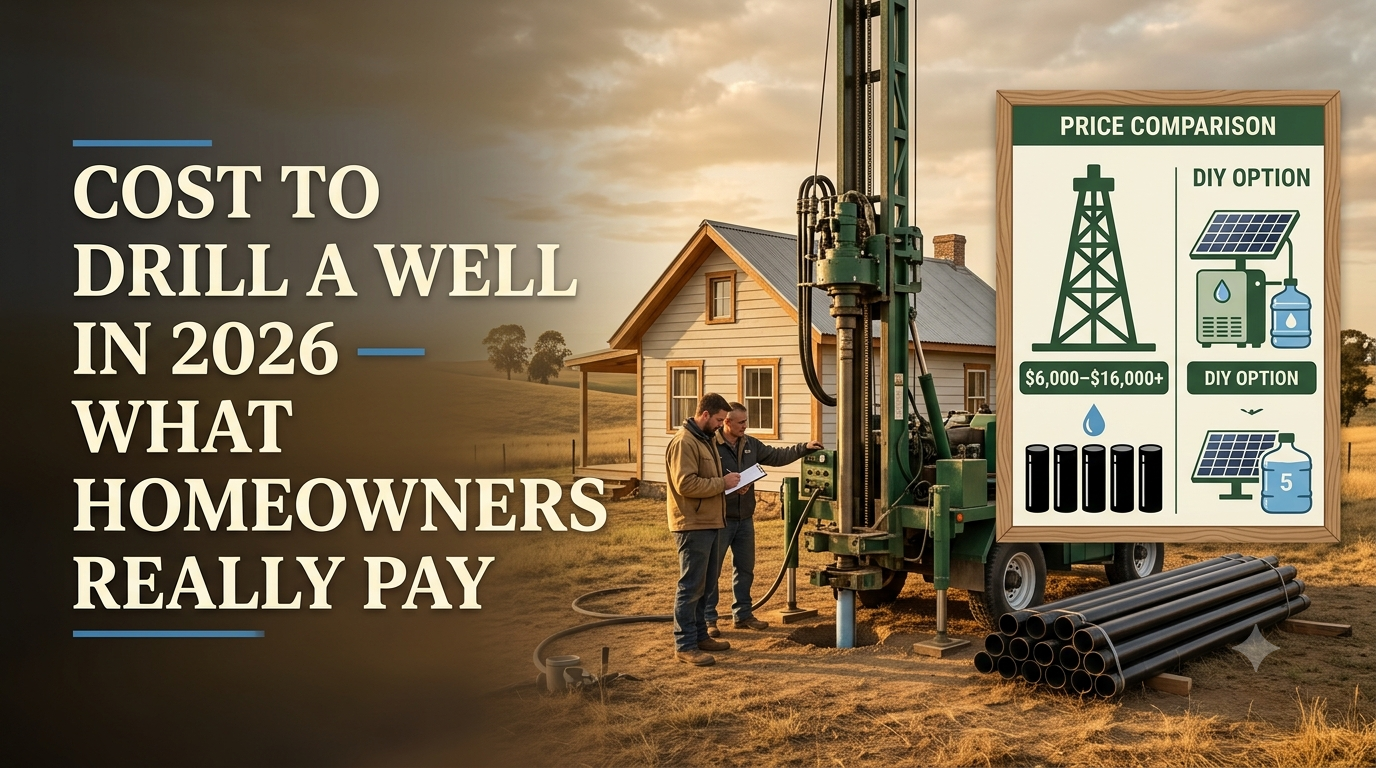
The cost to drill a well can be a rude awakening. A homeowner may hear “$25 to $65 per foot” and assume the math is simple, then discover the final bill also includes casing, a pump, electrical work, trenching, permits, pressure tanks, and water testing.
For a standard residential drilled well, many 2026 estimates put the total project around $6,000 to $16,000. But difficult geology, deep groundwater, hard rock, remote access, or extra infrastructure can push the final cost far beyond that.
I’ve seen people focus so hard on the drilling quote that they forget the hole in the ground is not yet a working water system. The well still needs a pump, power, plumbing, protection, and a water-quality plan.
This guide explains realistic well-drilling costs, the price factors most people miss, how to compare contractor quotes, and why it may be smart to have a separate water-backup plan even after your well is installed.
How Much Does It Cost to Drill a Well in 2026?
In 2026, the cost to drill a well commonly ranges from about $25 to $65 per foot for residential drilling. A typical completed household well, including basic drilling, casing, a pump, pressure tank, permits, and testing, often lands between roughly $6,000 and $16,000.
That is a national estimate, not a promise. A shallow well in easy soil may cost less, while a deep hard-rock well can cost $20,000, $30,000, or more once all components are included.
According to a 2026 residential well-cost guide, the drilling portion alone often runs $25 to $65 per foot, while a complete 100- to 200-foot system may cost around $5,500 to $15,000. The final number changes based on geology, well depth, materials, labor, and local permit requirements.
Here is the basic math people use first:
Estimated drilling cost = estimated well depth × drilling price per foot
For example, a 200-foot well at $40 per foot would have a basic drilling estimate of about $8,000. But that does not automatically include the pump, casing upgrades, electrical connection, water line, testing, or site restoration.
- Shallow or simple well: Often starts around $3,500 to $7,000.
- Typical residential well: Often costs about $6,000 to $16,000 installed.
- Deep or hard-rock well: Can exceed $20,000 or more.
- Drilling-only pricing: Commonly ranges from $25 to $65 per foot.
- Complete system pricing: Includes drilling plus pump, casing, pressure tank, permits, plumbing, and testing.
The best thing I can say here is: don’t compare a drilling-only quote with a complete-system quote and assume one contractor is cheaper. It is an apples-to-wrenches comparison, and it gets confusing fast.
Ask every contractor exactly what is included. Get it in writing. If the quote seems too good to be true, it may only cover the first part of the project.
Well Drilling Cost Per Foot: Why the Price Changes So Much
The largest factor in the cost to drill a well is usually depth. Deeper wells require more labor, more drilling time, more casing, more fuel, and sometimes stronger pumps.
But depth is not the whole story. The type of ground under your property can change the price dramatically.
Soft soil, sand, clay, and loose gravel may be quicker to drill than hard granite, dense limestone, or fractured bedrock. Rocky conditions can wear down equipment, slow progress, and require specialized drilling methods.
Some 2026 price guides estimate easier soil conditions at around $25 to $40 per foot, sedimentary rock at roughly $35 to $55 per foot, and hard rock at $55 to $85 per foot or higher. These are broad estimates only, but they show why no one can accurately price a well from a satellite image and a zip code.
- Soft soil or sand: Often the least expensive drilling environment.
- Clay and gravel: Can be manageable but may require casing and careful drilling.
- Sandstone or limestone: Often falls into a middle pricing range.
- Granite or dense bedrock: May require slower, more expensive drilling methods.
- Deep water table: Adds labor, materials, pump requirements, and overall cost.
I’ve learned not to trust a “per-foot” number without asking one important follow-up: Per foot of what, exactly? Is it drilling only? Drilling plus casing? Does it include the first 100 feet but charge more beyond that?
Also ask if the contractor charges extra for mobilization, difficult access, drilling through rock, abandoned holes, dry holes, or work that goes beyond the estimated depth. Those are the surprise charges that can turn a reasonable plan into an expensive one.
What Is Included in the Total Cost of a New Water Well?
A drilled borehole is just the beginning. To get running water into a home, the well needs several parts working together.
This is where a lot of estimates become confusing. One contractor may quote drilling and casing. Another may quote a full water-well installation. A third may include a pump but not electrical work or trenching to the house.
Before signing anything, ask for an itemized quote. If the contractor refuses to explain the parts of the estimate, that is not a great sign.
- Drilling: Creating the borehole to the required depth.
- Well casing: Pipe that keeps the borehole stable and helps protect the water source.
- Well screen: May be used in certain formations to keep sediment out.
- Submersible pump: Moves water from the well to the surface.
- Pressure tank: Helps maintain household water pressure and reduces pump cycling.
- Electrical work: Connects the pump, control box, and power source.
- Water line trenching: Runs water from the well to the home below frost depth.
- Permit and inspection: Required in many counties and states.
- Water testing: Checks for bacteria and other local contaminants.
A typical submersible pump may cost hundreds to several thousand dollars depending on depth, horsepower, flow needs, and brand. A pressure tank can also cost several hundred dollars or more.
Electrical hookup is another easy item to overlook. If your new well sits far from the main electrical panel, trenching and running dedicated wiring can add a meaningful amount to the job.
One 2026 guide estimates common add-ons around $800 to $1,800 for a submersible pump, $600 to $1,500 for a pressure tank, $1,000 to $3,000 for electrical hookup, and $100 to $500 for permits. Local estimates can be very different, though, so treat those as planning ranges rather than fixed prices.
Permits, Water Testing, and Legal Requirements for Private Wells

Private wells are regulated differently across the United States. Your state, county, local health department, water district, and even your property’s location can affect what is required.
Some areas require permits before drilling. Others require setback distances from septic systems, livestock areas, property lines, fuel tanks, and potential contamination sources.
Please do not skip this part just to save a few bucks. A poorly placed or unpermitted well can cause legal issues, contamination risks, expensive corrections, and headaches when selling the property later.
The U.S. Environmental Protection Agency’s private well guidance explains that private well owners are responsible for testing, maintaining, and treating their water because private wells are not regulated like public water systems.
- Check permit requirements before hiring a drilling contractor.
- Ask about required setbacks from septic tanks, livestock, and contamination sources.
- Confirm whether a licensed driller must file a well log or completion report.
- Budget for initial bacteria testing and local contaminant testing.
- Test private well water regularly after installation, flooding, repairs, or changes in taste, odor, or appearance.
The Centers for Disease Control and Prevention recommends testing private well water at least once a year for total coliform bacteria, nitrates, total dissolved solids, and pH, while also checking for contaminants common in your local area.
Testing costs can range from a basic bacteria test to more extensive lab panels for arsenic, lead, nitrate, iron, manganese, pesticides, or other regional concerns. This is money well spent. Clear water can still contain contaminants you cannot see or smell.
What Makes a Water Well More Expensive?

There are the obvious cost factors, like depth and rock. Then there are the sneaky ones.
A property can look flat and accessible, but the drilling rig may have trouble reaching the proposed site. A contractor may need extra setup time, special equipment, or a longer route for water and electrical lines.
In some places, the first location drilled does not produce enough water. This is known as a dry hole or low-yield well situation, and it is one of the financial risks that needs to be discussed before work begins.
- Deep groundwater levels that require more drilling and a stronger pump.
- Hard rock, boulders, fractured bedrock, or difficult geology.
- Remote properties with long travel distances for equipment.
- Limited access for large drilling rigs.
- Long trenching distances from the well to the house.
- Low-yield wells that require storage tanks, larger pumps, or another drilling attempt.
- Water-treatment equipment for iron, sulfur, bacteria, hardness, arsenic, or other quality issues.
- Winter drilling, permit delays, or labor shortages in high-demand areas.
One thing I would ask a driller directly is: “What happens if we hit rock, need to go deeper, or do not get the expected yield?”
It may feel awkward, but you want the answer before the rig arrives. A clear contract should explain the per-foot rate, what counts as a completed well, what happens with a dry hole, and which extras require your approval.
How to Compare Well Drilling Quotes Without Getting Burned

Getting three quotes is smart. But collecting three random totals is not enough.
Ask every contractor to quote the same scope of work, or you will end up comparing completely different projects. One quote may look cheap because it leaves out the pump, trenching, pressure tank, electrical connection, or testing.
A good contractor should be willing to talk through the expected depth, casing type, pump size, water-yield target, permit process, estimated timeline, and what could change the final bill.
- Request at least three written, itemized well-drilling estimates.
- Confirm the drilling rate per foot and whether casing is included.
- Ask for the expected well depth based on nearby wells and local records.
- Ask whether pump, pressure tank, plumbing, electrical, permits, and testing are included.
- Ask how dry-hole risk, rock drilling, deeper drilling, and change orders are billed.
- Check license status, insurance, references, and local reputation.
- Get a copy of the well log and test results after completion.
The National Ground Water Association’s WellOwner resources are a useful place to learn more about private-well ownership, maintenance, and questions to ask well professionals.
The lowest price is not always the best deal. I’d rather work with a contractor who explains the unknowns honestly than one who promises a suspiciously low total without discussing drilling conditions.
Is Drilling a Well Worth It for Your Property?
Drilling a well can be worth it if public water is unavailable, connection fees are high, your property is rural, or you want more independence over your household water supply.
But a private well is not “free water.” It has upfront drilling costs, electricity costs, pump maintenance, periodic testing, possible water treatment, and the risk that groundwater levels or water quality may change over time.
I think a well is best viewed as a long-term infrastructure investment. Like a roof or septic system, it can be extremely valuable, but it still needs maintenance and planning.
- A well may make sense where municipal water is unavailable or unreliable.
- Compare drilling costs with municipal connection fees and monthly water bills.
- Research local groundwater depth, well yield, and water-quality history.
- Budget for testing, maintenance, pump replacement, and treatment systems.
- Keep backup drinking water even if you have a private well.
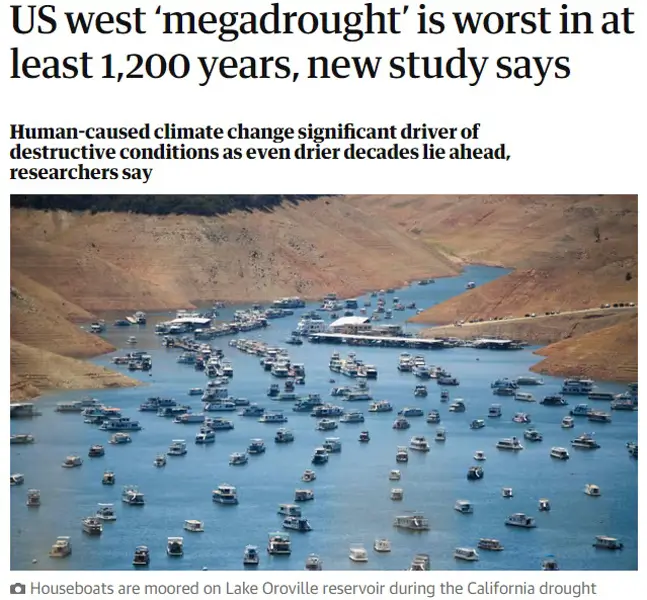
If you are in an area with falling groundwater, drought conditions, or frequent well problems, ask local drillers and neighbors about the real trends. They will usually tell you more than a national cost calculator ever can.
A well is a valuable water source, but it is not a reason to stop thinking about emergency storage or other backup options.
Affordable Water Backup Options Beyond a New Well

If drilling a new well is outside your budget, delayed by contractor schedules, or simply not practical for your property, you still have options for building water resilience.
Start with the basics. The CDC recommends storing at least one gallon of water per person per day for at least three days in an emergency. That is not a permanent water solution, but it is the simplest backup layer any household can create.
Depending on local law and your setup, you may also consider rainwater collection, larger water-storage tanks, water filtration, hauled water, or a small supplemental atmospheric-water system.
- Store emergency drinking water in clean, food-grade containers.
- Use a quality water filter and maintain replacement filters.
- Check local rules for rainwater harvesting and storage tanks.
- Inspect existing well equipment before paying for a full replacement well.
- Consider a supplemental water-from-air system only after evaluating local humidity, power use, and water treatment.
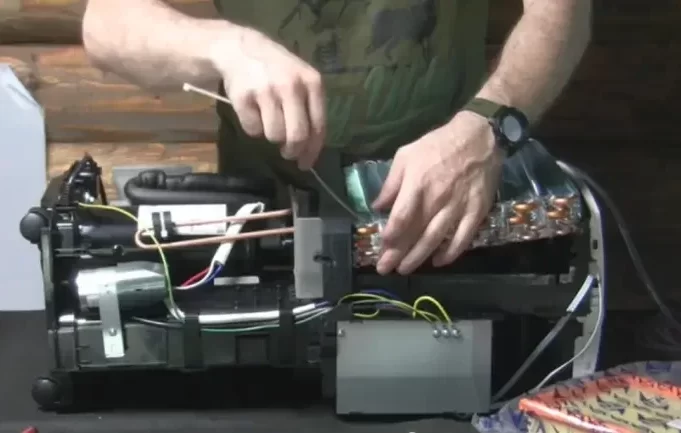
Joseph’s Well is marketed as a step-by-step digital guide for building a personal atmospheric water generator. The vendor says the guide includes instructions, plans, a materials list, and off-grid power information.
Its advertised cost and water-output claims should be treated as vendor marketing claims, not guarantees. Real results depend on humidity, temperature, electricity use, equipment quality, maintenance, and water-safety practices.
If you want to compare this route with the cost of drilling a well, you can read the Joseph’s Well review first. It is useful to understand the claimed build process and limitations before you spend money.
Can a DIY Atmospheric Water Generator Replace a Drilled Well?

For most households, a DIY atmospheric water generator should not be expected to replace a properly designed, productive drilled well. A well can provide larger quantities of water when groundwater is available and the system is maintained.
An atmospheric water generator collects water by condensing moisture from the air. Its output can vary sharply based on humidity, temperature, equipment design, operating time, and power availability.
That means a water-from-air system may make more sense as a supplemental backup for drinking water, emergency preparedness, or off-grid experimentation than as the only household water source.
The EPA’s technical brief on atmospheric water generation notes that AWG-produced water requires careful treatment and water-quality monitoring before it is used as drinking water.
- Check local humidity and dew-point conditions before building an atmospheric water system.
- Plan for electricity or correctly sized solar-and-battery power.
- Use food-safe materials, covered storage, filtration, disinfection, and testing.
- Keep stored water and conventional backup options even if you add an AWG.
- Do not assume vendor output claims will match your local conditions.
If you want to see the product details directly, you can view the Joseph’s Well DIY system here. Read the sales information carefully, compare it with local drilling quotes, and think about what role a supplemental system could realistically play in your water plan.
Conclusion: Plan for the Full Cost, Not Just the Hole
The cost to drill a well in 2026 can range from a few thousand dollars to well over $20,000, depending on depth, geology, equipment, location, permits, water treatment, and the rest of the installation.
The smartest move is to get written, itemized quotes and ask what happens if the drilling gets deeper, hits hard rock, or produces less water than expected. A well is a major investment, so clarity beats a cheap-looking number every time.
Whether you choose a new private well, municipal water, storage tanks, rainwater collection where legal, or a supplemental atmospheric-water system, build your water plan in layers. Reliable water is rarely one single purchase.
Sources and Further Reading
- U.S. Environmental Protection Agency: Private Wells
- Centers for Disease Control and Prevention: Testing Private Well Water
- Centers for Disease Control and Prevention: Emergency Water Supply
- National Ground Water Association: WellOwner Resources
- U.S. Environmental Protection Agency: Atmospheric Water Generation Technical Brief
- Joseph’s Well Review