
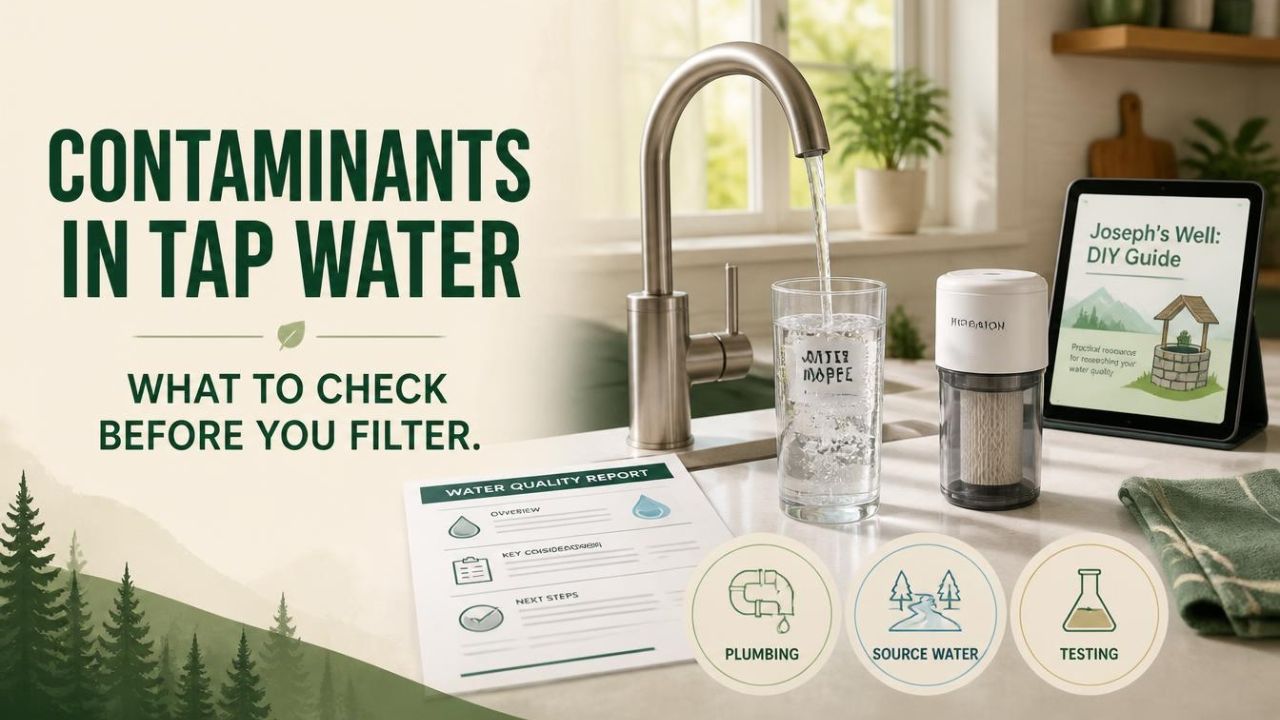
When I look at information about contaminants in tap water, I start with three questions: what was detected, how much was found, and what does that mean for this particular household? A frightening list of chemical names cannot answer those questions by itself.
This guide explains the main contaminant groups, where they come from, how to check your supply, and how to choose a sensible response without panic shopping.
Which Contaminants Can Be Found in Tap Water?
The main groups include microorganisms, metals and other inorganic chemicals, organic chemicals, disinfectants, and disinfection byproducts. The EPA’s drinking-water regulations organize these categories and explain their sources and potential health effects.
These are contaminants worth understanding, not a claim that every household has all of them. A detection also does not automatically mean the concentration exceeds a drinking-water standard.
Lead, copper, arsenic, and nitrate
Lead and copper can enter water through corrosion of household plumbing. Arsenic can come from natural deposits, while nitrate can enter water through fertilizer runoff, sewage, and leaking septic systems, according to the EPA.
Nitrate deserves particular attention where infants may consume the water. EPA identifies infants younger than six months as especially vulnerable to nitrate concentrations above its drinking-water limit.
Microorganisms
Potential microbial concerns include certain bacteria, viruses, and parasites such as Giardia and Cryptosporidium. Public-water treatment requirements are designed to control these risks; their inclusion in a regulatory list does not mean they are routinely present in properly treated tap water.
PFAS and other organic chemicals
PFAS are a large group of manufactured chemicals associated with industrial activities, certain consumer products, and some firefighting uses. Other organic contaminants can include pesticides and solvents, with local sources determining which substances deserve investigation.
Disinfectants and their byproducts
Chlorine and chloramine are deliberately added to control germs. The CDC explains that permitted low levels protect drinking water; they should not be confused with evidence that treatment has failed.
Disinfection byproducts, including trihalomethanes and haloacetic acids, form when disinfectants react with material in water. These are monitored separately because excessive exposure over time can present health concerns.
- Identify the specific substance instead of treating all contaminants as identical.
- Check the measured concentration and reporting units.
- Separate health concerns from taste, odor, and staining complaints.
- Look for local evidence rather than assuming a nationwide list describes your faucet.
Where Do Drinking-Water Contaminants Come From?
I find it easiest to think of drinking water as a journey: source, treatment, distribution, and household plumbing. A problem can arise at different points along that journey, which changes what you should investigate.
The EPA’s contaminant tables identify sources ranging from natural mineral deposits to agricultural runoff, industrial discharges, and corrosion. “Natural” and “manufactured” are not useful shortcuts for deciding whether a substance is safe.
For example, naturally occurring arsenic can require treatment, while a controlled chlorine residual helps prevent illness. Context matters more than whether a chemical name sounds familiar.
Source water may come from a reservoir, river, or groundwater well. Depending on local geology and land use, the substances requiring attention can differ substantially.
After treatment, water travels through a distribution network and eventually your building’s pipes. EPA identifies household plumbing corrosion as a source of lead and copper, so a utility-wide report cannot describe every individual faucet perfectly.
The CDC also explains that germs can enter water as it travels through pipes. Maintaining a disinfectant residual is one reason utilities use chlorine or chloramine.
- Ask your utility whether your supply comes from surface water, groundwater, or a mixture.
- Check whether the concern involves the source, the wider system, or your plumbing.
- Tell a laboratory about nearby agriculture, industrial activity, or known local contamination.
- Do not assume your neighbor’s result is identical to yours.
For a hypothetical example, imagine two neighboring homes receiving the same treated water. One has newer plumbing, while the other has older materials that require investigation for lead.
The shared water source is only part of the story. That is why I would investigate a suspected plumbing issue before spending money on an unrelated backup-water gadget.
How to Find Out What Is in Your Water
For a community water supply, start with the annual Consumer Confidence Report, often called a CCR. The EPA’s consumer guidance explains how these reports describe local drinking-water quality and detected regulated contaminants.
You can request the report from your supplier or use EPA’s search resources. Read the actual document rather than relying on a screenshot that leaves out the reporting period or units.
My suggested reading order is simple: source description, contaminant table, violation notices, and the utility’s explanation. This keeps the most useful information together.
Watch the difference between a measured result and a regulatory limit. Also check whether the number is a range, average, or highest detected value, because those are not interchangeable.
- Find the report for the utility that actually serves your address.
- Check the reporting year and sampling dates.
- Read the units carefully, including milligrams versus micrograms per liter.
- Look for violations and any instructions for customers.
- Contact the utility if a result or footnote is unclear.
If your concern involves a specific faucet, household plumbing, or a private supply, arrange appropriate laboratory testing. Ask your state drinking-water program or health department which certified laboratory and test panel fit the situation.
Follow the laboratory’s collection instructions exactly. A sample collected for lead may require different preparation from a sample collected for bacteria, so improvising can undermine the result.
I would use a home test kit as a screening tool only when its limitations are understood. A handheld meter or color strip should not replace a contaminant-specific result when the question affects drinking-water safety.
Keep your report, laboratory findings, and any treatment records together. Having that folder ready makes conversations with a utility, laboratory, or installer much more productive.
Choose Treatment for the Actual Contaminant
Here is where I would slow down before buying anything. A filter should be selected for the substance you want to reduce—not simply because the box says “pure,” “premium,” or “advanced.”
The EPA’s PFAS filter guidance explains that certification can verify particular reduction claims. It also emphasizes that filters and membranes need replacement according to their instructions.
Activated carbon, ion exchange, and reverse osmosis can reduce selected contaminants when the system is designed for them. That does not mean every product using one of those technologies performs equally.
For PFAS, EPA identifies products with relevant NSF/ANSI 53 or 58 reduction claims as options to investigate. Check the specific model’s listing, because a standard number alone does not tell you every contaminant covered.
Also avoid treating certification as a promise of zero contamination. EPA notes limitations in how existing PFAS certifications relate to newer drinking-water limits.
- Match the product’s certified claim to the contaminant in your report.
- Check the exact model number, replacement cartridge, and rated capacity.
- Budget for ongoing cartridges, membranes, and maintenance.
- Follow installation and flushing instructions.
- Consider follow-up testing where a health-related contaminant requires verification.
Boiling is not a universal chemical-removal method. EPA specifically warns that boiling does not remove lead and can increase its concentration as water evaporates.
Likewise, a basic carbon taste filter should not be assumed to disinfect unsafe water. The appropriate response to a microbial advisory may differ from the response to lead, nitrate, or an industrial chemical.
Picture a household buying a countertop filter because the tap water smells of chlorine. Improving taste may be the goal, but that purchase does not automatically answer a separate concern about nitrate.
I would write the actual target contaminant at the top of the shopping checklist. It is a small step, but it helps stop marketing language from taking over the decision.
If officials issue a do-not-drink or do-not-use notice, follow that notice rather than improvising a treatment method. Ask the utility or health department what alternative supply is appropriate.
Build a Water Backup Without Assuming It Is Safer
Water quality and water availability are different questions. A household may want a backup for interruptions even when its normal tap water meets applicable standards.
However, switching sources does not automatically improve safety. A new source introduces its own questions about collection materials, treatment, storage, upkeep, and verification.
Joseph’s Well is presented by its vendor as educational information and DIY plans. The sales page includes a results-vary disclaimer; it should not be treated as independent evidence that a homemade system produces safer water than your utility.
You can read the Joseph’s Well review as an additional research step. Compare its statements with the current offer and ask for supporting evidence before relying on performance or safety claims.
My suggested approach is to keep the purchase decision separate from any immediate contamination concern. A guide is not a substitute for a safe alternate supply, a laboratory result, or a treatment system selected for your actual contaminant.
- Confirm that you are buying a digital guide rather than finished equipment.
- Ask what parts, power, maintenance, and testing the project requires.
- Request evidence supporting any drinking-water claims.
- Compare the full project cost with treating your existing supply.
- Check current purchase and refund terms before ordering.
If the project still interests you, inspect the current Joseph’s Well offer with that checklist beside you. Curiosity is useful; assuming an unfamiliar source is automatically cleaner is not.
Conclusion: Check the Evidence Before Changing Your Water
Contaminants in tap water can include metals, microorganisms, agricultural pollutants, industrial chemicals, and disinfection byproducts. Which ones matter to you depends on your source, plumbing, measured concentrations, and local conditions.
Start with your water-quality report. Arrange targeted testing when needed, then choose treatment with verified claims for the substance you actually need to reduce.
A DIY backup project can be a separate preparedness interest, but it does not establish drinking-water safety. Evaluate Joseph’s Well as a guide—not a guarantee—and put testing and appropriate treatment ahead of promotional promises.