
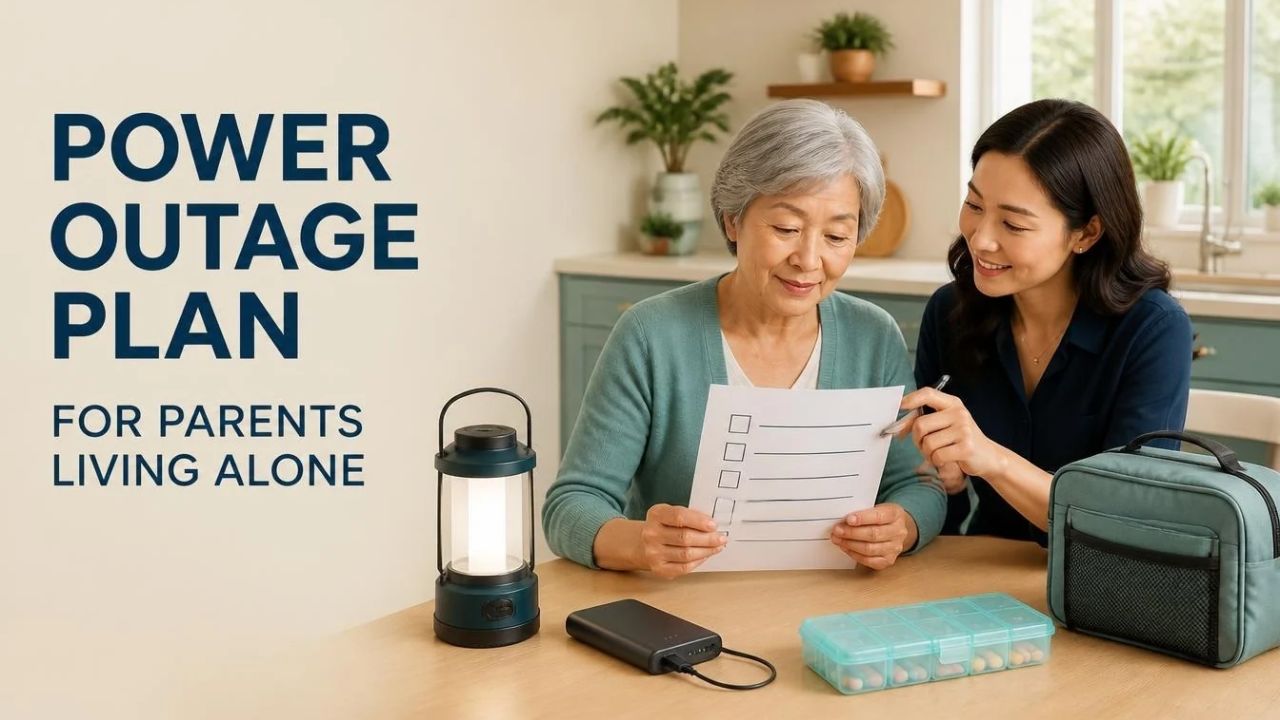
A power outage plan for elderly parents living alone should cover more than flashlights. It needs medical backups, reliable people, accessible supplies, and a clear decision about when to leave.
Most importantly, build it with your parent, not around them. Let’s make the next safe step clear without turning their home into a bunker!
Affiliate disclosure: This article contains affiliate links. If you purchase through them, we may earn a commission at no additional cost to you.
1. Start With Your Parent’s Daily Needs and Medical Risks

I’d begin with a walk through an ordinary day. Ask your parent what they use from getting out of bed to settling down at night, then note which tasks depend on electricity or another person.
Ready.gov’s guidance for older adults recommends assessing individual needs, making a plan, and engaging a support network. That approach is more useful than assuming every older person needs the same kit.
Imagine a parent who manages comfortably most days but cannot use the apartment elevator during a blackout. Their transport plan may deserve just as much attention as their spare batteries.
- List medical devices and anything else that needs electricity.
- Record mobility, hearing, vision, and communication needs.
- Note medications, allergies, pharmacy details, and prescribing clinicians.
- Identify daily tasks that become difficult without lighting or powered equipment.
- Ask which help your parent would welcome and who they trust.
For powered medical equipment, arrange the plan with the treating clinician and equipment supplier. FDA guidance says to check whether a device can use batteries or a generator and to seek emergency services immediately if a life-sustaining device cannot be used.
I’d put the important answers on one large-print sheet. Include equipment names, supplier numbers, and the steps approved by the care team rather than relying on anyone’s memory.
If your family wants broader preparedness reading, David’s Shield’s educational material may appeal to readers who prefer a Christian-oriented presentation. Its seller describes educational information and DIY plans—not a substitute for professional advice or a medical backup system.
2. Build a Check-In Network That Does Not Depend on One Phone

A plan that says “I’ll call Mom” leaves a lot unanswered. What if you’re driving, your battery is flat, or the call simply doesn’t connect?
I’d assign three roles: the lead family contact, a nearby helper, and a backup person. Ask each person before writing their name down, and agree on what they can realistically do.
Ready.gov recommends a support network and suggests that at least one trusted person have an extra key, know where supplies are kept, and understand relevant lifesaving equipment or medication assistance.
- Lead contact: coordinates updates and keeps the written plan current.
- Nearby helper: can check in locally when conditions permit.
- Backup helper: steps in if the first two people are unavailable.
- Transport contact: knows the destination and any accessibility needs.
- Parent’s role: knows whom to contact and where the paper instructions are.
Set check-in times that match your parent’s needs and the expected conditions. I wouldn’t treat a once-a-day call as enough for someone whose medical backup may run out sooner.
Write a missed-contact sequence: try the agreed alternative, contact the nearby helper, then escalate according to the circumstances. A missed call alone is not proof of injury, but an immediate medical threat should not be handled as a routine callback.
Keep printed numbers by the phone and in the emergency bag. Agree on key access or another entry arrangement with your parent’s consent rather than improvising it later.
Also test the technology you already own. Ready.gov advises checking whether home phones work without power and how long their backup lasts.
Ask the medical alert provider about battery duration, cellular or internet dependence, and what happens when those connections fail. Don’t assume a reassuring button means the whole system remains available.
3. Plan Safe Backup Power and Medication Storage

This is where I’d slow down and ask professionals specific questions. “We have a power bank” is not the same as “this backup can safely run this medical device.”
The FDA recommends checking manufacturer instructions or contacting the supplier about alternate power. Document the approved connections, operating limits, and realistic battery duration for the actual equipment and settings.
- Confirm the backup power source is suitable for the device.
- Write down charging, testing, and replacement instructions.
- Agree on when to relocate, allowing time before backup power is exhausted.
- Ask who can provide help if the equipment fails.
- After power returns, check device settings as directed by the manufacturer.
Ask the utility about medical-needs registration or available assistance programs. Treat registration as an additional precaution—not a promise that the electricity will stay on or return first.
Medication needs a separate written plan. FDA guidance recommends an updated medication list, emergency refill planning, and arrangements for medicines that require refrigeration.
Ask the pharmacist for product-specific temperature limits and instructions if storage conditions are exceeded. If a cooler is recommended, clarify how to pack it without exposing medicine to unsuitable temperatures.
Don’t use a universal rule for every insulin or refrigerated prescription. The FDA advises following the product’s storage instructions and consulting a pharmacist, clinician, or manufacturer when temperature control is lost.
If a portable generator is part of the plan, the CDC says it must stay outdoors, at least 20 feet from windows, doors, and vents. Never operate one inside a home, basement, or garage, and use battery-powered carbon monoxide detection.
For optional background reading, compare the David’s Shield review with the seller’s current information. I would not use a general survival guide to replace professional medication or medical-device instructions.
4. Set Up an Accessible Outage Kit and a Safer Home

I’d choose supplies your parent can comfortably use, not the most impressive-looking gadgets. Ask them to operate the flashlight, open the food, and lift the emergency bag before deciding everything is ready.
Ready.gov recommends flashlights for household members, along with nonperishable food, water, and alternative charging options. Its older-adult guidance also emphasizes supplies suited to individual needs.
- Place easy-to-operate battery lights beside the bed and usual chair.
- Keep a charged phone backup and the correct cable together.
- Store suitable ready-to-eat food and a manageable drinking-water supply.
- Include glasses, hearing-aid supplies, hygiene items, and other personal essentials.
- Keep paper contacts, medication information, and necessary documents accessible.
I’d clear the route between the bed, bathroom, main chair, and exit. Put supplies within comfortable reach rather than asking your parent to climb, bend deeply, or move heavy containers in darkness.
Temperature deserves its own decision—not just another blanket in the bag. Ready.gov recommends going to a location with power when heat or cold makes staying home unsafe.
Discuss individual limits with the care team, particularly when health conditions or medicines complicate temperature tolerance. There isn’t one indoor temperature or waiting period that is appropriate for every parent.
The CDC warns against using grills or camp stoves indoors. Unsafe improvisation is not a substitute for an agreed relocation plan.
If “is a microwave a faraday cage” is on your research list, keep it separate from these immediate priorities. This article does not verify microwave shielding, and medical backup planning should not depend on an unverified enclosure.
My organizing preference is one clearly marked home kit plus a manageable departure bag. Label both in print your parent can comfortably read.
5. Write Relocation Triggers and Practice the Plan Together

The hardest question may be, “When do we leave?” I’d agree on that before the outage, with your parent involved and medical guidance included where needed.
Ready.gov recommends planning around power-dependent equipment and identifying alternative facilities when ongoing treatment requires them. A destination must meet the actual need, not simply have lights on.
Confirm accessibility, power availability, transport, and any necessary medical support. Do not assume every shelter or cooling location can accommodate specialized equipment or care.
- Destination: where your parent will go and the backup option.
- Trigger: the agreed condition that starts relocation.
- Transport: who drives and what happens if that person is unavailable.
- Equipment: what must travel and who can move it safely.
- Communication: who receives the departure and arrival updates.
Possible triggers include an official evacuation order, the clinician-approved battery threshold, or conditions that make the home unsafe. Leave enough time for transport rather than waiting until the last usable battery is nearly empty.
If a life-sustaining device becomes unavailable, follow the FDA’s advice to seek emergency services immediately. Don’t delay urgent help while trying to complete a routine family pickup.
Now try a short tabletop exercise: “The power just failed—show me the light, the contact sheet, and the first action.” No need to disconnect medical equipment or create a real hazard.
For a hypothetical parent who cannot manage stairs, the exercise might reveal that the chosen driver also needs accessible transport assistance. That is useful information, not a failed drill.
Review the sheet whenever health needs, equipment, contacts, or living arrangements change. If you want additional general reading, explore David’s Shield as an optional learning resource, after the practical and medical arrangements are in place.
Conclusion: Make the First Safe Step Easy
Preparation should support your parent’s independence, not take it away. Build the power outage plan for elderly parents living alone around their needs, preferences, and trusted support network.
Start with medical backups, clear check-ins, accessible supplies, and a destination that can meet their needs. Then practice the first few steps together.
For optional further reading, compare the David’s Shield review with the seller’s current details. Keep professional advice and your parent’s actual care requirements at the center of every decision.