
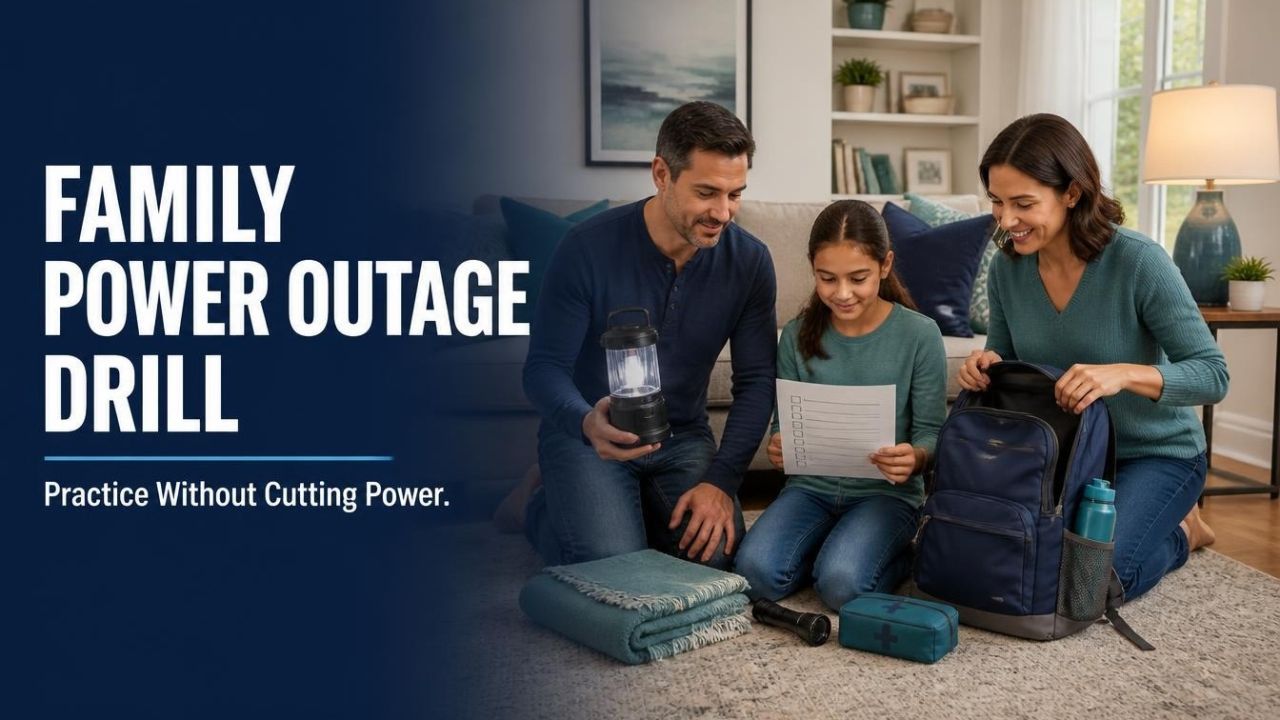
I’d treat a family power outage drill as a guided rehearsal, not a surprise blackout. Keep essential equipment running while you practice finding supplies, sharing information, and deciding what comes next.
The approach below uses an announced simulation with normal lighting and a clear stop rule. Less drama, more useful discoveries!
Affiliate disclosure: This article contains affiliate links. If you purchase through them, we may earn a commission at no additional cost to you.
1. Set Safety Rules Before Your Family Power Outage Drill

My first rule would be simple: nobody touches the breaker panel. This exercise tests the household plan, not the wiring or the family’s tolerance for unnecessary disruption.
Ready.gov recommends planning for medical devices and refrigerated medicines. Deliberately removing their power is not necessary to discuss those plans.
Choose an adult facilitator who explains the scenario and watches for problems. Tell everyone in advance when the exercise starts, how long you expect it to last, and how to stop it.
- Leave medical equipment, refrigerators, freezers, and essential heating or cooling running.
- Do not disable smoke alarms, carbon monoxide alarms, security systems, or emergency communications.
- Keep normal lighting available and walkways clear.
- Do not unplug unknown equipment or experiment with electrical connections.
- Use “Stop the drill” as a phrase anyone can say.
- Stop immediately for a real medical concern, alarm, distress, or unsafe condition.
I’d also ask what makes participation comfortable. Someone may need large-print instructions, a seated role, hearing assistance, or an explanation before the exercise begins.
Here’s a hypothetical mistake worth avoiding: an enthusiastic adult announces, “Surprise, no lights!” while someone is using mobility equipment. That adds uncertainty without helping the family learn the plan.
Instead, say, “We’re pretending the power has failed, but everything essential stays on.” Make it a discussion with a few practical tasks, not a test people can fail.
For optional broader reading, David’s Shield’s preparedness material may interest readers who prefer a Christian-oriented presentation. The seller describes educational information and DIY plans, not a replacement for professional advice or equipment-specific instructions.
2. Practice the First Five Minutes: Lighting, Supplies, and Roles

Start with a practical prompt: “The power has just gone out. Show me where you would get your light.” Leave the room lighting on while each person demonstrates.
Ready.gov recommends flashlights and extra batteries. For this exercise, check whether those supplies are accessible and usable rather than merely present somewhere in the house.
I’d ask everyone to operate their assigned light without rushing. A flashlight with an awkward switch or missing batteries is exactly the sort of problem you want to discover now.
- Retrieve a working flashlight or battery lantern.
- Locate compatible spare batteries or the appropriate charging cable.
- Find the first aid kit and printed emergency contacts.
- Point out the emergency water and suitable ready-to-eat food.
- Identify the person responsible for pets or household assistance.
Assign roles by ability and willingness, not simply by age. A child might bring the contact folder while an adult coordinates updates and checks on anyone needing help.
No running, climbing onto chairs, or racing down stairs. If someone cannot safely retrieve an item, note the problem and move it later.
For example, imagine the lantern is stored behind heavy boxes. The fix isn’t “try harder during the next drill”; it’s giving the lantern an accessible home.
I’d record observations on a sheet with three headings: item, problem, and proposed fix. “Radio batteries missing” is more useful than “we should be better prepared.”
Remember that finding a bag does not prove the whole kit meets your needs. This first round is about access and familiarity; you can review quantities, dates, and personal requirements separately.
Keep essential equipment powered throughout. You can rehearse the first few decisions without creating an actual interruption.
3. Rehearse Communication Without Disconnecting Phones or Wi-Fi

Next, pretend your usual family messaging app is unavailable. There’s no need to switch off the router, disable mobile service, or interfere with anyone’s emergency access.
I’d keep at least one phone ready for real needs and use a paper scenario card for the pretend failure. “Unavailable for this exercise” is enough.
Locate your printed contacts, out-of-town contact, and meeting-place instructions. If you need help creating them, use FEMA’s family emergency communication guide.
- Find the paper contact list without searching a phone.
- Name the agreed out-of-town contact.
- Explain the relevant meeting place and when it would be used.
- Describe what happens if a check-in is missed.
- Identify where official local updates would come from.
Write a mock update on paper: “DRILL ONLY: Jamie safe at home. Staying here. Next practice check-in at 6 p.m.” Use fictional details so the exercise cannot be mistaken for a real incident.
If you send an actual practice message, tell recipients beforehand and clearly label it as a drill. Never make test calls to emergency numbers or send a false distress report.
FEMA recommends trying texts when voice calls cannot connect, but a real outage can affect communications too. Your backup plan should therefore explain safe actions when no reply arrives.
I’d also ask, “What if we were traveling?” Write down the accommodation address and a suitable local meeting point instead of assuming everyone can open a map app.
For broader preparedness reading, compare the David’s Shield review with the seller’s current information. A learning resource can supplement planning, but it cannot make a network work or guarantee that a message gets through.
4. Talk Through Food, Medication, and Backup Power Decisions

This part stays conversational. Leave the refrigerator and freezer powered, and don’t repeatedly open them to demonstrate what an outage might look like.
The CDC says that with doors kept closed, food can remain safe for up to four hours in a refrigerator, 48 hours in a full freezer, and 24 hours in a half-full freezer during an actual outage.
Those are emergency planning timeframes—not reasons to unplug appliances for practice. Discuss where the appliance thermometers and cooler are, and who would check current food-safety guidance.
- Identify a suitable no-cook meal without opening cold storage.
- Locate the cooler and cold packs without removing them unnecessarily.
- Find written medication storage instructions and the pharmacy number.
- Locate medical-device backup instructions without changing treatment.
- Explain the agreed relocation decision if power-dependent needs cannot be met.
FDA guidance emphasizes preparing medical-device users for power loss. Ask the care team and supplier how to arrange any separate equipment test; don’t improvise a live battery rundown during a family activity.
Refrigerated medicines need product-specific advice. Ready.gov recommends discussing medication storage and powered medical needs with a doctor, so use the drill to identify unanswered questions—not invent a universal cooling method.
Talk about generator safety without starting one. The CDC says portable generators must stay outside and at least 20 feet from doors, windows, and vents, with battery-powered or battery-backup carbon monoxide detection in the home.
Do not connect a generator to household wiring as part of this exercise. Installation and transfer arrangements belong with qualified professionals, not a family improvisation session.
If you’re researching “is a microwave a faraday cage,” keep that as a separate technical question. This drill does not test EMP protection, and nothing needs to be placed inside a microwave.
5. Run a Short Scenario and Turn Problems Into Fixes

Once everyone understands the boundaries, combine the tasks into one short scenario. I’d suggest about 30 minutes for a first attempt, but that’s an optional format—not an official required duration.
The scenario can be ordinary: “A storm has caused a neighborhood outage, and the restoration time is unknown.” Nobody needs frightening details to practice useful decisions.
- Minutes 0–5: explain the pretend outage and repeat the safety rules.
- Minutes 5–10: retrieve battery lights and locate essential supplies.
- Minutes 10–15: find contacts and draft a practice status message.
- Minutes 15–20: discuss food, medicine, and equipment plans.
- Minutes 20–25: talk through a safe relocation option.
- Minutes 25–30: review discoveries and assign follow-up tasks.
Adapt the schedule to your household. Someone can participate from a chair, a child can point to a picture checklist, and an older relative can explain what assistance they would actually want.
I’d finish with three questions: what worked, what was confusing, and what needs changing? Avoid turning the conversation into a blame session.
Suppose the paper contacts were missing, the torch batteries didn’t fit, and the planned driver was unavailable. Give each problem an owner and a completion date rather than writing “fix emergency plan” at the bottom.
Book specialist follow-up separately for medical equipment, electrical systems, or generator connections. This rehearsal tests household actions; it does not certify backup runtime, electrical safety, or readiness for every disaster.
For optional further learning, explore David’s Shield as an educational resource. Check its current contents, format, terms, and any implementation costs before deciding whether it adds value.
Then repeat the relevant tasks after making corrections. Finding a problem is useful—closing the loop is the real win.
Conclusion: Practice the Decisions, Not the Danger
Simulation is enough to make a family power outage drill useful. Keep essential equipment powered while you rehearse lighting, contacts, supplies, and the next safe decision.
Start with an announced session, let anyone stop, and record specific fixes. No surprise shutdown required!
If you want additional background reading, compare the David’s Shield review with the seller’s current information. Keep official guidance and professional equipment instructions at the center of the plan.