
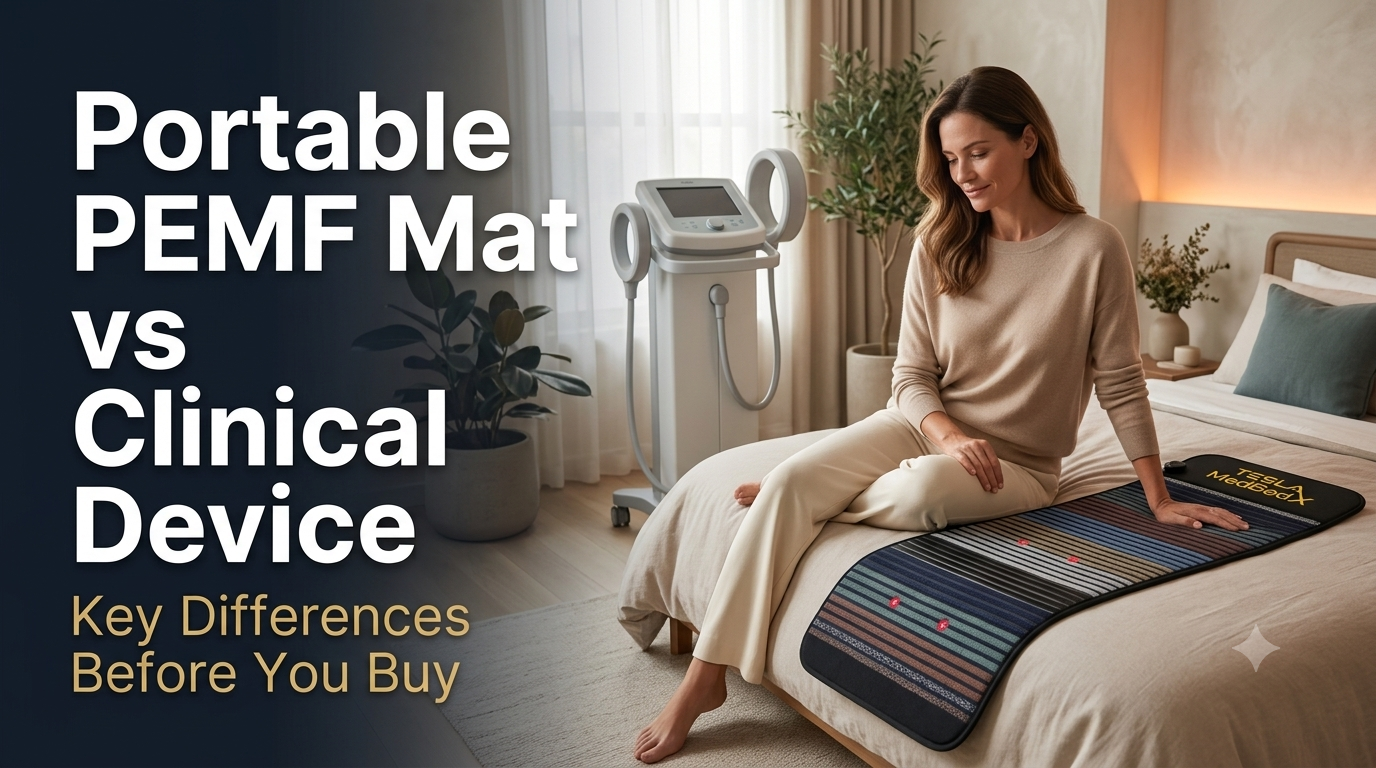
I used to think PEMF was PEMF. A mat at home, a device in a clinic, a prescription bone stimulator—same technology, so basically the same thing, right?
Not really. That was my first big lesson after reading product pages, manuals, and FDA guidance more carefully. A portable PEMF mat vs clinical device comparison is not mainly about which one looks fancier or costs more. It is about intended use, regulatory status, evidence, safety, and whether a clinician is involved.
Both categories use pulsed electromagnetic fields. But a consumer wellness mat is not automatically a substitute for a prescribed device used for a specific medical indication. Let’s make the differences clear before you spend money or make a health decision.
What Is a Portable PEMF Mat?

A portable PEMF mat is generally a consumer wellness product built for home use. People commonly consider one for a calmer evening routine, general relaxation, ordinary muscle stiffness after a long day, or a low-effort alternative to adding another appointment to the calendar.
Some mats include more than PEMF. You might see infrared heat, red light, magnets, vibration, crystals, negative ions, or other features packed into one product. That sounds impressive, but it also means you need to understand each feature separately.
My first mistake was focusing only on the headline feature. “PEMF mat” sounded simple enough. Then I noticed some models also create heat, some have several programs, and some promote claims that were much broader than the product instructions. That is a sign to slow down.
A general-wellness product may be intended to support relaxation, stress management, or a healthy lifestyle. FDA’s general-wellness framework focuses on products intended for general health activities that present low risk and do not claim to diagnose, treat, cure, or prevent disease. FDA general wellness guidance explains this distinction.
- Portable PEMF mats are commonly sold for home wellness and general relaxation.
- Many combine PEMF with infrared heat or other comfort-oriented features.
- A consumer setting number does not prove clinical equivalence or medical effectiveness.
- General wellness language should not be confused with disease-treatment claims.
If your goal is a screen-free ritual before bed or a more comfortable way to unwind after normal daily tension, a portable mat may fit that kind of routine. Just keep the label honest in your own head: wellness support, not medical treatment.
What Is a Clinical PEMF Device?
A clinical PEMF device is a different category. These systems are designed for specified medical uses and are often prescribed, supervised, or used as part of a clinician-directed treatment plan.
The best-known example is a PEMF bone-growth stimulator. Certain devices have FDA-cleared indications related to specific bone-healing situations, such as selected non-union fractures or spinal fusion support. Those indications are narrow and device-specific.
FDA explains that device requirements depend on the device’s classification, risk, and intended use. Some Class I and most Class II devices require a 510(k) premarket notification, while higher-risk products may require a more stringent pathway. FDA’s device marketing overview explains these pathways.
This is important: a clinical bone stimulator is not just a stronger wellness mat. It may have a defined protocol, a specific coil design, precise parameters, documented directions, and use tied to a diagnosis made by a qualified professional.
For example, a person with a fracture that is not healing should not buy a general wellness mat and assume it provides the same medical benefit as a prescribed bone-growth device. That can delay appropriate care, and frankly, it is not a gamble worth taking.
- Clinical PEMF devices are intended for specific medical uses, not broad wellness claims.
- Some are prescribed and used under clinician direction.
- Protocols may be tied to a diagnosis, procedure, treatment area, and timeline.
- Clinical bone-growth systems are not interchangeable with consumer PEMF mats.
If a doctor recommends a device after surgery or for a bone-healing issue, follow that device’s instructions. Do not try to recreate the protocol with a different mat from the internet. Similar-sounding technology is not the same treatment.
FDA Clearance, Approval, and General Wellness Claims
This is the part that gets messy online. Sellers sometimes use “FDA approved,” “FDA cleared,” “FDA registered,” and “medical grade” like they all mean the same thing. They do not.
For many medical devices, FDA clearance refers to the 510(k) pathway. In a 510(k), a manufacturer generally demonstrates that a device is substantially equivalent to a legally marketed predicate device in intended use, technological characteristics, and performance testing as needed. FDA’s 510(k) overview explains what this pathway means.
“FDA-cleared” also does not mean a device has been cleared for every possible benefit mentioned in advertising. A PEMF device cleared for a particular bone-healing indication is not automatically cleared for sleep, anxiety, inflammation, chronic pain, or athletic recovery.
Low-risk general-wellness products may fall under FDA enforcement discretion when they are intended to encourage a healthy activity or general state of health and do not make disease claims. That is different from FDA clearance for a specific medical purpose. FDA’s general wellness policy describes the boundaries.
- FDA-cleared commonly describes a specific regulatory pathway and intended use.
- FDA-cleared does not mean approved for every advertised health outcome.
- “FDA registered” does not by itself prove that a device is FDA-cleared or FDA-approved.
- General-wellness positioning is different from a medical claim or clinical indication.
Here is my rule now: if a product claims a regulatory status, I want the exact product name, the exact intended use, and a way to verify it. Vague badge graphics do not count.
Output, Features, and Evidence: Why Specs Are Not Enough
PEMF devices can vary a lot. Frequency, waveform, field strength, coil placement, surface area, session length, and treatment protocol can all differ. Add infrared heat or vibration and the comparison gets even more complicated.
That is why “this mat has a higher intensity” is not a complete buying argument. Higher output is not automatically more effective, more comfortable, or more appropriate. In some cases, it might simply mean a different experience.
Evidence has to match the product and the claim. Research on a prescribed clinical device for a non-union fracture cannot automatically be used to prove that a portable consumer mat improves sleep, treats an injury, or speeds healing in every home user.
FDA-cleared PEMF bone-growth systems have narrow clinical uses. By contrast, broad claims for consumer PEMF mats—such as guaranteed pain relief, inflammation reduction, deep sleep, detoxification, or complete recovery—often extend beyond the strongest evidence available.
Before you trust a study link on a sales page, ask three questions: Was this exact product studied? Were the settings comparable? Were the people in the study similar to you and your goal?
- PEMF frequency, waveform, coil design, and session time can vary between devices.
- More intensity does not automatically mean better results.
- Clinical evidence for one device and indication cannot be copied onto every PEMF mat.
- Product-specific claims need product-specific support.
This sounds picky, but it has saved me from a lot of sales-page logic. A scientific-looking citation at the bottom of a page is not the same thing as evidence for the exact mat in your cart.
Safety and Supervision Differences
Whether a PEMF product is clinical or consumer-facing, safety comes first. A clinical device may come with a prescribed plan, patient screening, and follow-up. A home mat puts more responsibility on the buyer to read the manual and recognize when they should not use it.
People with a pacemaker, implantable cardioverter-defibrillator (ICD), cochlear implant, insulin pump, neurostimulator, or another implanted electronic medical device should not use PEMF unless their treating specialist and device manufacturer explicitly confirm that it is safe.
Medtronic lists PEMF therapy products and magnetic mattress pads or pillows among products not recommended for people with its implantable cardiac devices. Medtronic’s electromagnetic compatibility guide is an important reference for people with its pacemakers and ICDs.
Pregnancy is another situation where safety data are limited. Do not assume a consumer wellness label makes a feature appropriate during pregnancy; speak with an obstetric clinician before use.
And there is a bigger practical point. A PEMF mat should never be used instead of getting care for a possible fracture, new weakness, numbness, severe pain, swelling after an injury, chest symptoms, or ongoing sleep problems. Those need proper evaluation.
- Read the full safety section and user manual before using any PEMF device.
- Do not use PEMF with implanted electronic medical devices without explicit specialist clearance.
- Avoid PEMF in pregnancy unless your obstetric clinician specifically approves it.
- Use clinical care for symptoms that may signal injury, disease, or a serious condition.
This may sound cautious, but good wellness decisions are supposed to make life simpler. They should not create a new risk because somebody skipped the boring part of the manual.
Which PEMF Option Fits Your Goal?
The right choice depends on your goal. If you have a diagnosed medical condition, a recent procedure, a suspected non-union fracture, or a clinician-directed treatment plan, start with the clinician—not a consumer wellness product search.
If you are healthy, have no contraindications, and want a low-effort option for general relaxation or ordinary daily stiffness, a portable mat might be worth considering. The standard should be modest and realistic: convenience and comfort, not a promise to solve a medical problem.
When comparing consumer mats, review the specifications, what each feature does, the safety warnings, session controls, warranty, returns, company contact details, and full cost. If a seller makes big claims, look for evidence that directly supports those claims.
If you are evaluating Tesla MedBed X as a general-wellness product, start with this detailed Tesla MedBed X review. It is also wise to read the official product information and safety directions before buying.
You can view Tesla MedBed X product details here if it fits your goal and you have reviewed the contraindications. This is an affiliate link, which means the publisher may earn a commission if you make a purchase at no additional cost to you.
- Choose clinician-directed care for diagnosed conditions and post-surgical treatment plans.
- Consider a consumer PEMF mat only for realistic general-wellness goals.
- Compare safety, instructions, warranties, and return policies before price alone.
- Do not buy a device because it promises to replace medical care.
Honestly, that is the whole thing. Pick the category that matches your need. A home mat can be a nice part of a routine, while a clinical device belongs in a medical plan. Trying to make one do the other’s job is where confusion starts.
Conclusion: Choose the Right Category, Not the Loudest Claim
In a portable PEMF mat vs clinical device comparison, the biggest difference is purpose. Clinical devices are designed and regulated for defined medical uses. Portable mats are typically general-wellness tools intended for home relaxation, comfort, or routine-based recovery support.
Both may use pulsed electromagnetic fields, but that does not make their evidence, protocols, safety considerations, or claims interchangeable. The best choice is the one that fits your actual goal and does not ask a wellness product to become a substitute for professional care.
If your goal is general at-home relaxation and you have no contraindications, you can explore Tesla MedBed X here after reviewing the product information, safety directions, and purchasing terms. If your goal is to manage a diagnosed condition, start with your clinician instead.
Sources and Further Reading
- How to Study and Market Your Device — U.S. Food and Drug Administration
- Premarket Notification 510(k) — U.S. Food and Drug Administration
- General Wellness: Policy for Low Risk Devices — U.S. Food and Drug Administration
- Electromagnetic Compatibility Guide — Medtronic
- Tesla MedBed X Review — LifeTranq