
Affiliate Disclosure: This article may contain affiliate links. If you purchase through a link, I may earn a commission at no additional cost to you. This article is for general education only. Follow equipment manuals, electrical codes, battery-safety instructions, and qualified electrician guidance for your installation.
A solar panel car battery setup off grid can power small devices when the grid is unavailable. It may run LED lights, a phone charger, a small fan, a radio, or other low-wattage equipment.
But the setup is not simply “connect a panel to a car battery and plug things in.” That shortcut can damage the battery, destroy electronics, create sparks, or cause a fire.
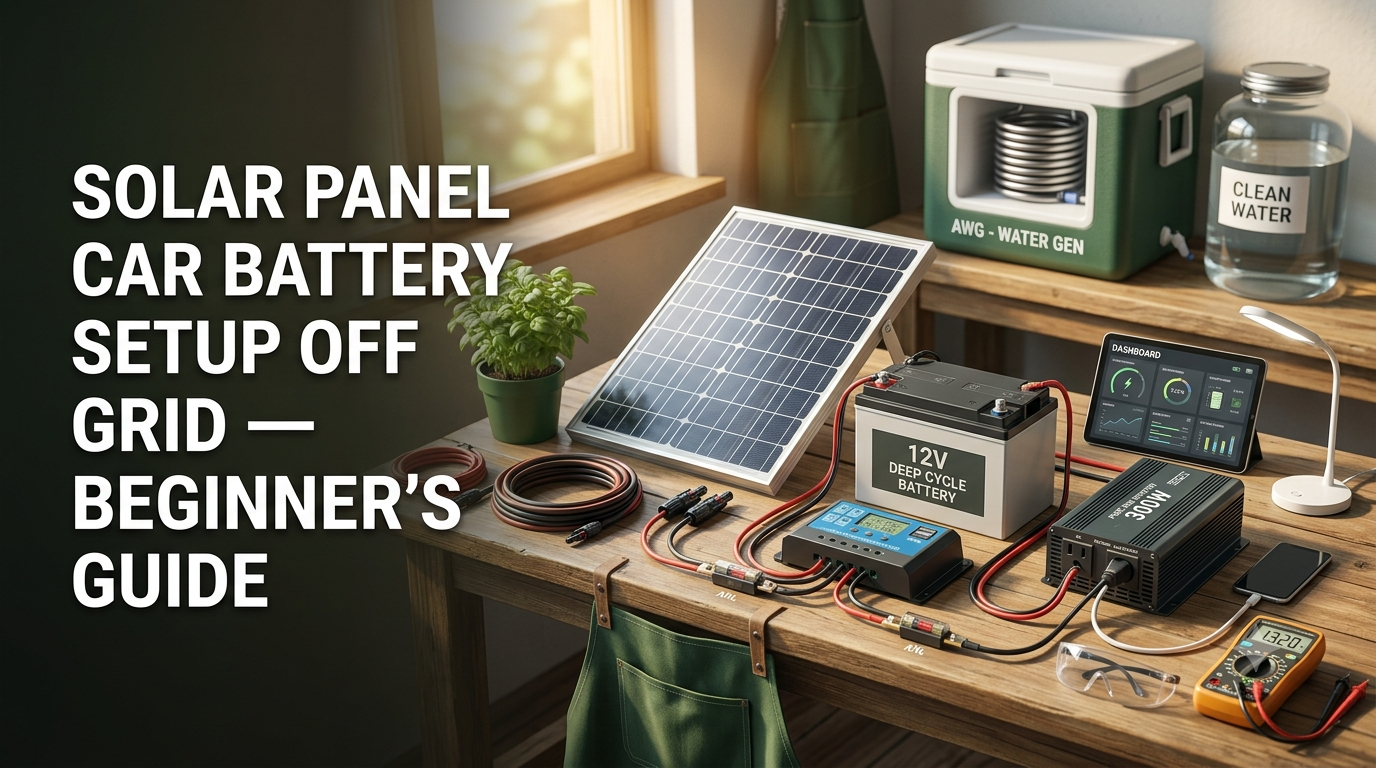
The basic system needs a solar panel, charge controller, battery, fuse protection, suitable cables, and sometimes an inverter. The parts must match each other, and the battery must be appropriate for repeated cycling.
This guide explains the components, sizing math, wiring order, common mistakes, and how an off-grid solar system may support small preparedness devices such as a water generator.
How a Solar Panel and Car Battery Setup Works

A solar panel produces direct-current electricity. A battery stores energy. A charge controller regulates the energy moving from the panel into the battery, and an inverter converts battery power from DC into household-style AC power when needed.
The U.S. Department of Energy’s consumer solar guide describes a typical solar-electric system as including solar panels, an inverter, a battery, a charge controller, wiring, and a support structure.
Each component has a different job.
- Solar panel: Converts sunlight into DC electricity.
- Charge controller: Regulates charging and helps prevent battery overcharging.
- Battery: Stores solar energy for use when sunlight is unavailable.
- Inverter: Converts DC battery power into AC power for compatible devices.
- Fuse or breaker: Protects cables and equipment from excessive current.
- Wiring and connectors: Carry energy between each component safely.
The order matters. Solar panel power should generally pass through the charge controller before reaching the battery. Loads may connect to the controller’s load terminals or directly to the battery through properly sized protection, depending on the system design.
One important beginner lesson: the battery is not a magic power source. It can only store a limited amount of energy, and repeatedly draining it too far may shorten its life.
Can You Use a Regular Car Battery for Solar Storage?

A regular car battery can power a small device in an emergency, but it is not normally the best choice for daily off-grid solar storage.
Most car batteries are designed to deliver a short burst of high current to start an engine. They are not designed to be deeply discharged and recharged over and over.
A deep-cycle battery is designed more specifically for repeated discharge. Marine deep-cycle batteries, AGM batteries, gel batteries, and lithium iron phosphate batteries are common options, depending on budget and system requirements.
Using a car battery occasionally may be reasonable, but draining it deeply can reduce its lifespan. The Department of Energy explains that batteries store solar energy for use when the sun is not shining, but battery selection and system design affect performance.
- Starting battery: Best for short, high-current engine starts.
- Deep-cycle lead-acid: Better suited for repeated off-grid cycling.
- AGM or gel battery: Sealed lead-acid options with different maintenance needs.
- LiFePO4 battery: Lightweight and cycle-friendly, but usually more expensive.
- Marine battery: Check whether it is true deep-cycle or a hybrid starting battery.
Do not mix different battery chemistries, ages, capacities, or brands in one bank without proper design advice.
Also, never use a damaged, swollen, leaking, frozen, or overheated battery. Lead-acid batteries can produce hydrogen gas during charging, so ventilation and spark control matter.
If you only need to charge a phone during a short outage, a small power station may be simpler. If you want a flexible long-term off-grid system, choose a battery designed for that job.
What Size Solar Panel Do You Need?

Panel size depends on how much energy your devices use each day and how much usable sunlight reaches the panel.
Start by listing every device. Find its wattage, estimate how many hours it runs, and multiply the two numbers.
Daily energy use = device watts × hours used per day
For example, a 10-watt LED light used for 5 hours consumes about 50 watt-hours. A 20-watt fan used for 4 hours consumes about 80 watt-hours. Together, those devices need approximately 130 watt-hours before system losses.
- Write down the running watts for every device.
- Estimate daily run time in hours.
- Multiply watts by hours to get watt-hours.
- Add energy for inverter, cable, controller, and battery losses.
- Use your location’s realistic or worst-season sun exposure.
- Add extra panel capacity for cloudy days and battery charging.
A panel’s nameplate wattage is not the same as its daily energy output. A 100-watt panel may produce much less than 100 watts during cloudy weather, morning or evening, shade, heat, dust, or poor orientation.
The Department of Energy recommends considering the complete photovoltaic system, including the solar array, battery, charge controller, inverter, and wiring. Panel size should be based on the entire load, not one optimistic afternoon.
For a small setup, a 100- to 200-watt panel may support lights, phones, radios, and other low-wattage devices. Larger loads require a much larger system.
How to Size the Battery Bank

Battery capacity is usually measured in amp-hours or watt-hours. Watt-hours are easier for beginners because they can be compared directly with device energy use.
For a 12-volt battery, the rough energy formula is:
Watt-hours = volts × amp-hours
A nominal 12-volt, 100 amp-hour battery contains about 1,200 watt-hours before accounting for usable depth of discharge, temperature, age, inverter losses, and battery chemistry.
You should not assume all 1,200 watt-hours are available. Lead-acid batteries are often used with a shallower discharge than lithium batteries, while manufacturer instructions vary.
- Calculate daily watt-hour demand.
- Choose how many days of battery autonomy you want.
- Account for the battery’s recommended depth of discharge.
- Include inverter and wiring losses.
- Add capacity for cloudy weather if the system is critical.
- Keep batteries within the temperature range specified by the manufacturer.
Suppose your devices use 300 watt-hours per day and you want one day of reserve. A 12-volt, 100 amp-hour battery may appear large enough on paper, but usable energy can be much lower after losses and discharge limits.
That is why sizing slightly larger is usually more comfortable than running a battery at its limit every day.
Do not rely on a battery’s voltage alone to estimate its remaining capacity. Voltage readings can be misleading when a battery is charging or under load. A battery monitor is more useful for serious systems.
Choosing the Right Charge Controller

The charge controller sits between the solar panel and battery. It manages charging voltage and current and helps protect against overcharging or excessive discharge.
Two common types are PWM and MPPT. PWM controllers can work for small, simple systems, while MPPT controllers are often more efficient, especially when panel voltage differs from battery voltage or when conditions are less than ideal.
The controller must match the battery voltage, solar-panel voltage, maximum current, battery chemistry, and system configuration.
The Department of Energy’s photovoltaic guidance explains that charge controllers protect batteries by preventing overcharge and over-discharge conditions.
- Match the controller to a 12-, 24-, or 48-volt battery system.
- Confirm the maximum solar input voltage.
- Confirm the controller’s maximum charging current.
- Choose settings compatible with lead-acid or lithium chemistry.
- Use a controller with temperature compensation when required.
- Leave capacity for future panel expansion.
One common error is buying a controller based only on panel wattage. The panel’s open-circuit voltage and short-circuit current also matter, especially in cold weather when voltage can rise.
Read the controller manual before connecting anything. Manufacturer diagrams exist for a reason, even if they look boring.
Do You Need an Inverter?
You need an inverter only if your device requires AC power. USB chargers, LED strips, 12-volt fans, and many small pumps can run directly from DC with the correct adapter.
An inverter changes battery DC into household-style AC. This makes it possible to run devices with standard plugs, but the inverter also consumes energy and adds another point of failure.
For electronics, a pure sine-wave inverter is often the safer choice. Some motors, chargers, medical devices, and sensitive electronics may not work correctly with cheaper modified-sine-wave inverters.
- Use DC devices directly when possible to avoid conversion losses.
- Choose an inverter with enough continuous wattage.
- Check the inverter’s surge rating for motor-starting loads.
- Use pure sine wave for sensitive electronics and many motors.
- Do not run a large heater, kettle, microwave, or power tool from a small battery system.
- Install proper fuses and ventilation according to the manufacturer’s instructions.
A small 300-watt inverter may run a laptop charger and a few lights. It will not run every appliance in a house.
Motor-driven equipment can have a startup surge several times higher than its running wattage. A small pump or refrigerator may trip an undersized inverter even when its label looks modest.
Always check both continuous and surge ratings.
Safe Wiring Order for a Small Off-Grid Solar System
Follow the wiring instructions supplied with your charge controller. Many small systems connect the battery to the controller first, then the solar panel, then the load or inverter, but the exact procedure varies by equipment.
Connecting the battery first allows some controllers to detect the battery voltage before solar input is applied. Do not assume this is universal; read your manual.
Use fuses close to the battery positive terminal. A battery can deliver enormous current into a short circuit, even if the solar panel is small.
- Mount components in a dry, ventilated, protected location.
- Use cables sized for the expected current and distance.
- Place fuses or breakers close to battery-positive connections.
- Confirm polarity before connecting each component.
- Connect the battery, controller, panel, and loads in the manufacturer’s sequence.
- Secure cables against abrasion, heat, water, and accidental pulling.
- Use a multimeter to check voltage and polarity before powering devices.
Never work around battery terminals with metal jewelry, loose tools, or wet hands. A dropped wrench can create a serious short circuit and a spectacularly bad afternoon.
If your setup is more than a tiny portable system, ask a qualified electrician or solar installer to inspect it. Local electrical codes may require specific disconnects, fuses, enclosures, grounding, and installation practices.
What Devices Can a Small Solar Battery System Power?
A small solar panel car battery setup off grid is best for low-wattage devices. Start with essential loads and avoid trying to make a small battery do the job of a full home system.
Good starter loads include LED lights, USB chargers, a small radio, a phone, a laptop used briefly, a low-wattage fan, and some communication equipment.
Water-generation equipment is more complicated. A condensation-based atmospheric water generator may use fans, compressors, pumps, or UV systems, all of which can draw significant energy.
- LED lights.
- Phones, tablets, and USB devices.
- Small radios and communication equipment.
- Low-wattage fans.
- Small DC pumps matched to the system.
- Selected laptops or monitors used for limited periods.
Before connecting an appliance, write down its running watts and startup surge. Then compare that with the inverter and battery limits.
Joseph’s Well is marketed as a DIY atmospheric-water-generator guide with instructions for on-grid and off-grid power options. The system’s real energy needs will depend on the actual design, local humidity, run time, and components used.
You can read the Joseph’s Well review to understand the product claims and decide whether the build fits your available solar capacity.
Simple Example: Sizing a Small 12-Volt Setup
Let’s work through a basic example. Imagine you want to run an LED light, charge a phone, and operate a small 12-volt fan.
The light uses 10 watts for 5 hours, the phone charger uses about 10 watts for 2 hours, and the fan uses 20 watts for 4 hours.
- LED light: 10 watts × 5 hours = 50 watt-hours.
- Phone charger: 10 watts × 2 hours = 20 watt-hours.
- Fan: 20 watts × 4 hours = 80 watt-hours.
- Estimated daily total: 150 watt-hours.
- Add system losses and extra margin before sizing the panel and battery.
A 100-watt solar panel might produce enough daily energy in strong sun, but not necessarily in winter, shade, heat, or cloudy conditions. A larger panel or extra battery capacity would provide more breathing room.
A nominal 12-volt, 50 amp-hour battery contains about 600 watt-hours before discharge limits and losses. That may support this small load for a while, but the actual usable energy depends on battery chemistry and manufacturer instructions.
This example is deliberately small. It teaches the method without pretending a tiny setup can power a whole home.
Write down your own loads and use conservative estimates. A system that works on paper but fails after one cloudy day is not a reliable off-grid system.
Using Solar Power for a DIY Water Generator
A water generator may be one of the most demanding devices in an off-grid preparedness plan. Condensation systems often use refrigeration, fans, pumps, controls, and filters.
Before connecting one, measure the actual running wattage with a power meter. Do not size your solar panel from a marketing phrase such as “low power” or “runs on solar.” You need the wattage, operating hours, surge requirements, and daily water target.
The Department of Energy’s solar design guidance emphasizes that a complete photovoltaic system includes more than panels. Batteries, inverters, charge controllers, wiring, and system losses all affect performance.
- Measure actual device wattage rather than guessing.
- Calculate daily energy use from expected run time.
- Plan extra capacity for cloudy weather and battery charging.
- Confirm the inverter handles compressor or motor startup surge.
- Use food-safe water-contact parts and proper water treatment.
- Test water output before relying on it for drinking.
Do not assume a car battery will run a compressor-based water generator for long. It may start the device, but repeated deep discharges can damage a starting battery quickly.
If you want to research a structured DIY water-from-air option, you can view the Joseph’s Well guide details. Compare the claimed power setup with your actual battery, panel, climate, and water needs.
Common Solar Battery Setup Mistakes
Most beginner failures are not caused by complicated engineering. They come from mismatched components, undersized wiring, poor battery care, or unrealistic load expectations.
The mistakes are easy to prevent once you know what to look for.
- Connecting a solar panel directly to a battery without a suitable controller.
- Using a starting battery for repeated deep-cycle operation.
- Choosing an inverter based only on running watts and ignoring surge load.
- Using cables that are too thin for the current and distance.
- Skipping fuses near the battery.
- Mixing incompatible battery types or ages.
- Installing batteries in a hot, wet, or poorly ventilated location.
- Ignoring the energy cost of inverter standby power.
- Expecting a small panel to charge a large battery during cloudy weather.
One mistake can cascade. An undersized panel leaves the battery partially charged, repeated deep discharges shorten battery life, and then the system appears to “stop working.”
Keep the design simple and document the system. Label cables, record battery type and capacity, save manuals, and write down fuse ratings.
Future-you will appreciate it. Especially when the lights are out and the labels are doing the remembering.
Conclusion: Size the System Around Real Loads
A solar panel car battery setup off grid can power useful small devices, but reliability comes from matching the panel, battery, controller, inverter, wiring, and load.
Start with daily watt-hour calculations. Choose a battery designed for repeated cycling, use a charge controller, protect the battery with fuses, and select an inverter with enough continuous and surge capacity.
Keep the first project small. Lights, phones, radios, and low-wattage fans are easier than compressors, heaters, pumps, or whole-house appliances.
If you want to power an atmospheric water generator, measure the actual device and plan for humidity, run time, energy losses, and safe water treatment. A little math before buying equipment can prevent a very expensive lesson.
Sources and Further Reading
- U.S. Department of Energy: Own Your Power Solar Electricity Guide
- U.S. Department of Energy: Solar Photovoltaic System Design Basics
- U.S. Department of Energy: Photovoltaic System Components
- National Renewable Energy Laboratory: Photovoltaics Design Principles
- University of Missouri Extension: Solar Electricity System Components
- Joseph’s Well Review